A note before the post: the `Write` tool is disabled this session, so I can't save the file to `src/content/blog/bathroom-storage-solutions-remodel.md` myself. The full post is below for you to paste in, or re-run me with write access and I'll save it.
---
The best bathroom storage solutions in a small Puyallup home go vertical and get built into the walls, not stacked on the floor. A recessed niche between the studs runs $300 to $800 during a remodel. A tall linen tower runs $400 to $1,800. A custom vanity with real drawers runs $1,200 to $3,500. Those three moves fix the storage problem in most of the 5x7 and 5x8 bathrooms I work in around Pierce County, and they do it without stealing the floor space you need to actually stand in the room.
I'm Brad Zemke. I've spent 20+ years in the trades as a third-generation carpenter, and I've run Pacific Remodeling here in Puyallup since 2018. The numbers below come from jobs I've bid and built in this market, not a national calculator that ignores how old these houses are.
## The Bathroom Storage Solutions That Actually Work in a Small Bath
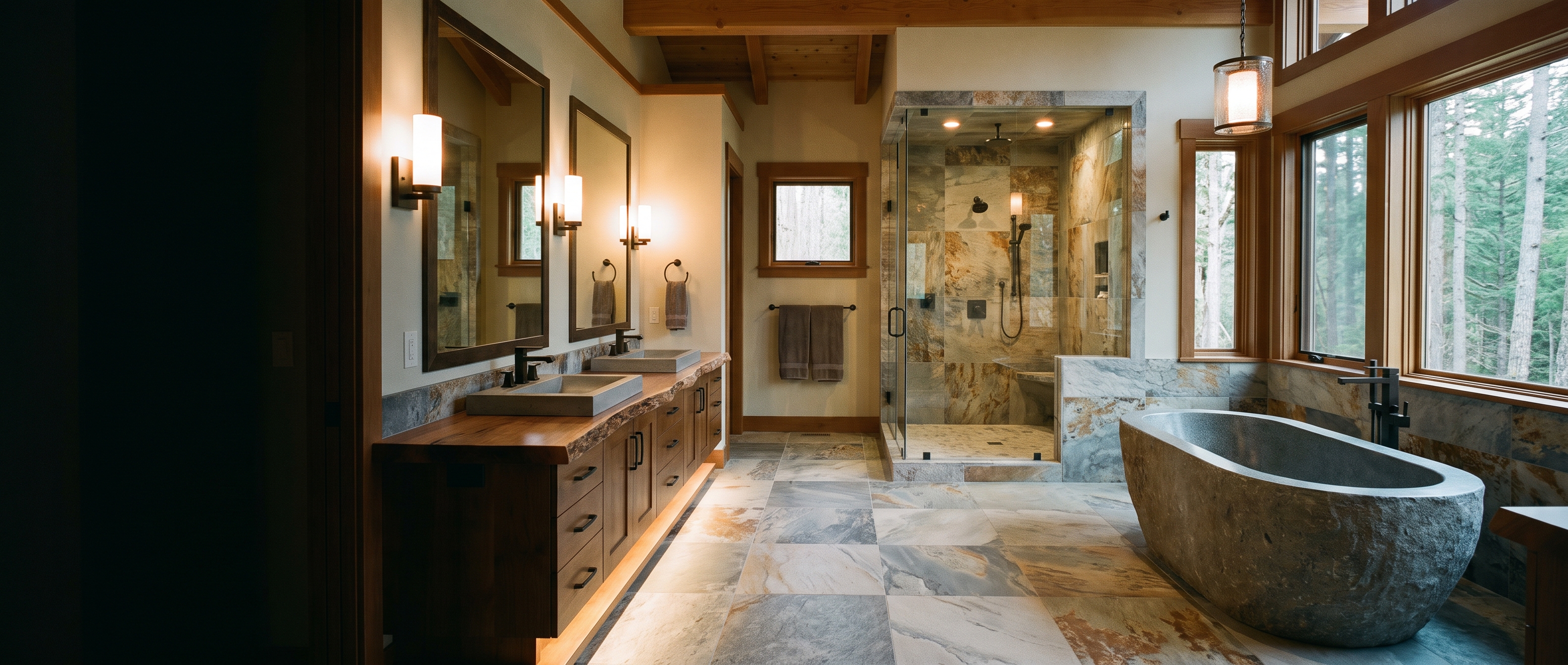
Here's the thing most homeowners get backward. They walk into a tiny bathroom and start shopping for floor cabinets. But the floor is the one thing you can't spare in a 5x7 room. The space you're not using is on the walls and up high.
So the storage ideas I reach for first all climb instead of sprawl.
- **Recessed niches.** A shelf carved into the wall cavity between two studs. Costs you zero floor space because it lives inside the wall.
- **Tall linen towers.** A narrow cabinet, 12 to 24 inches wide, that runs floor to near-ceiling. Small footprint, huge capacity.
- **Over-toilet storage.** The dead air above the tank is prime real estate. A cabinet or shelf there holds a week of towels.
- **Vanity drawers instead of a door and a shelf.** Drawers pull out. You see everything. A single cabinet door with one shelf wastes most of the cube behind it.
- **Pull-out columns.** A 6-to-9-inch slide-out next to the vanity. It swallows bottles and brushes in a gap most people ignore.
I use that keyword a lot with clients: bathroom storage solutions. What they usually mean is "I have no room and my counter is covered in stuff." The answer is almost never a bigger bathroom. It's smarter use of the one you have.
> **Worth knowing:** In a bathroom under 40 square feet, every move should go up or into the wall. Floor cabinets are the last resort, not the first idea.
## Recessed Niches and Medicine Cabinets: Storage Hidden in the Walls
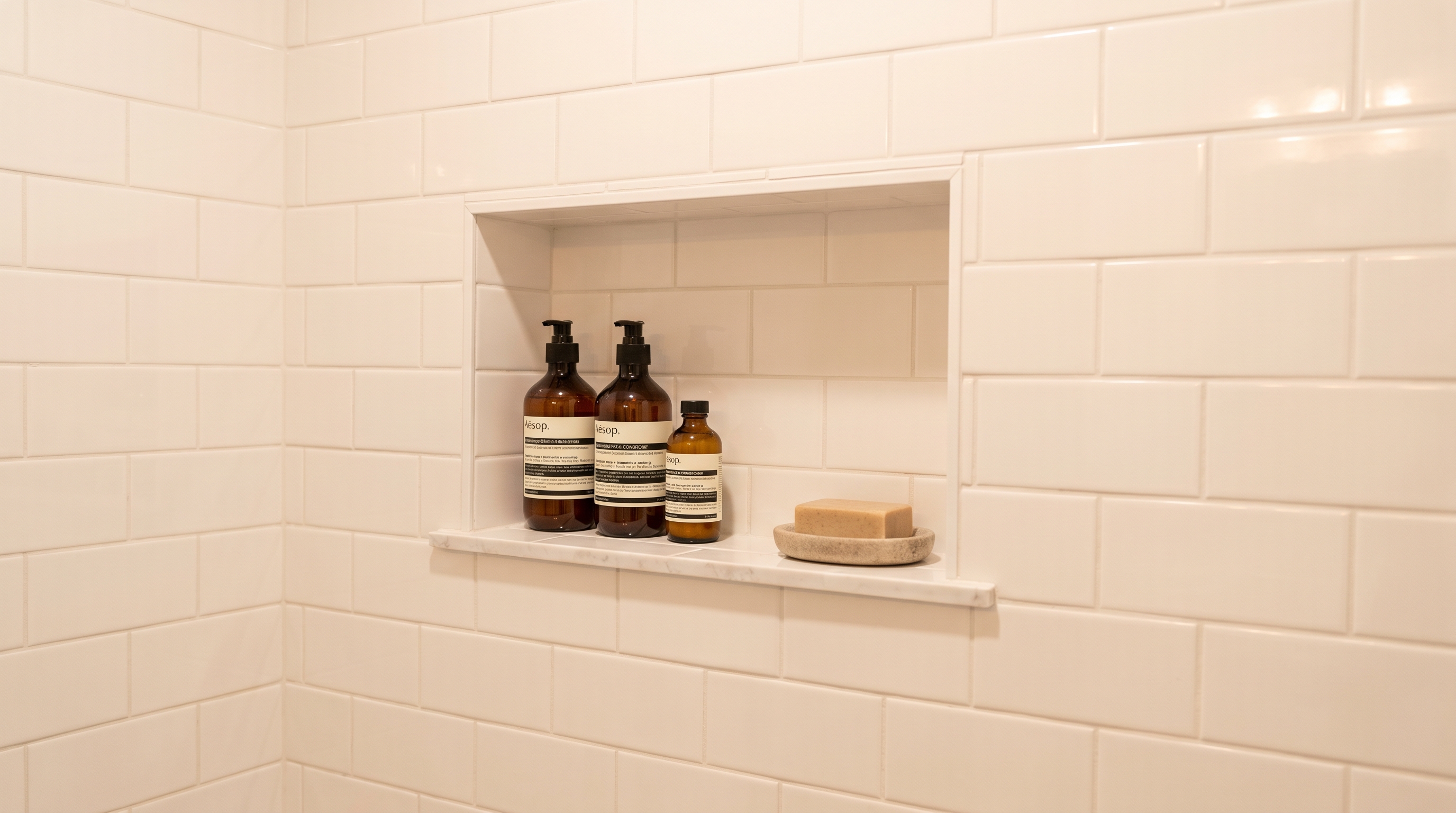
A recessed niche is my favorite trick. You build the shelf into the wall cavity, so the storage sits flush with the drywall or tile. Nothing sticks out into the room. In a shower, a niche holds shampoo and soap without a corner caddy that rusts and falls off in two years.
Pricing depends on timing. Cut it in during an open-wall remodel and a niche runs $300 to $800. Try to add one to a finished wall later and it jumps to $900 to $1,800, because now I'm locating studs, checking for plumbing and wiring, cutting drywall, and patching everything back.
### The old-home catch most people miss
Here's a Pierce County detail that bites homeowners. A lot of Puyallup, Sumner, and Graham houses from the 1940s through the 1970s were framed with 2x4 walls. That gives you a 3.5-inch cavity. A deep recessed medicine cabinet from a showroom might need 4 inches or more. It won't fit without building out the wall face.
So before you fall in love with a deep recessed cabinet, I measure the actual cavity. Sometimes the fix is a shallower unit. Sometimes I fur out the wall an inch. Either way, you find out before demo, not after.
One more thing on niches. Skip the exterior walls. In our climate those walls carry insulation and a vapor barrier, and cutting into them to recess a cabinet compromises both. I keep recessed storage on interior walls and use surface-mount on exterior ones.
- [ ] Confirm the wall is interior, not exterior
- [ ] Scope the cavity for plumbing and wiring before cutting
- [ ] Measure cavity depth (many old PNW homes are 3.5 inches)
- [ ] Decide recessed vs. surface-mount based on that depth
- [ ] Add low-voltage LED strip if the niche is a display feature ($75 to $200)
> **Cost callout:** A recessed niche costs $300 to $800 when the wall is already open. Waiting until after the remodel can triple that. Plan it into the demo, not after the tile goes up.
## Vanities, Drawers, and Why Cabinet Material Matters Here
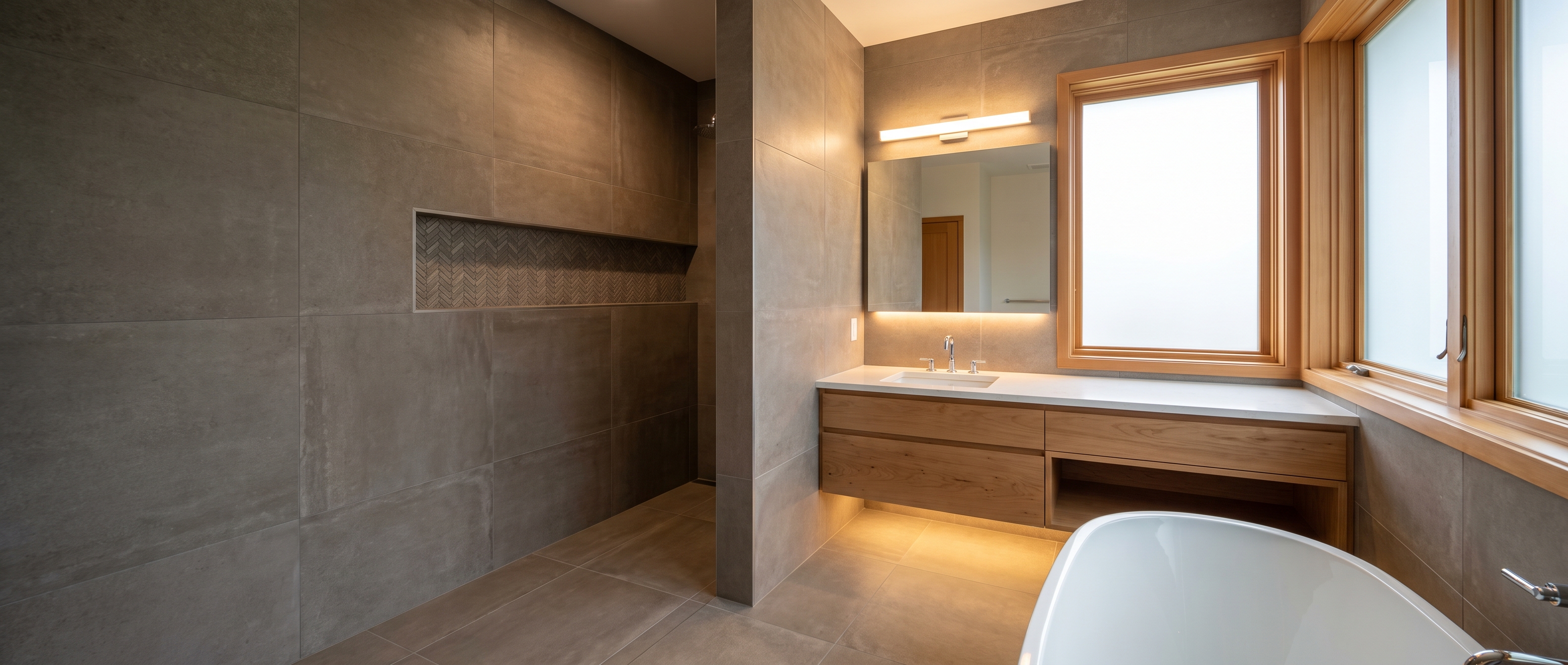
Your vanity is the biggest single piece of storage in most bathrooms. Spec it wrong and you waste the whole cabinet. Spec it right and it carries most of the load.
The first choice is drawers versus a plain cabinet. A cabinet with one door and one shelf looks cheaper on the bid, and it is. But you lose most of the usable space to dead air you can't reach. Drawers pull the contents out to you. For daily stuff, drawers win every time. I usually do one door section for tall bottles and cleaning supplies, and a bank of drawers for everything else.
Here's what the vanity tiers run installed in Pierce County right now:
| Vanity Type | Cost Range | What You Get |
|---|---|---|
| Stock, 30"-48", door-and-shelf | $500 - $1,200 | Basic storage, builder-grade boxes |
| Semi-custom with drawer bank | $1,200 - $3,500 | Soft-close drawers, better materials |
| Shop-built custom | $3,500 - $7,000+ | Dovetail drawers, exact fit, any finish |
The detail that separates a vanity that lasts from one that fails in five years is the box material. This matters more here than almost anywhere.
### Moisture is the real enemy in a PNW vanity
Pierce County bathrooms stay humid. Not occasionally. All winter. That sustained moisture is brutal on cheap cabinet boxes. Particleboard and standard MDF swell at the toe-kick and the drawer bottoms, and I see failures in poorly vented bathrooms within three to five years. The joints puff up. The drawer bottoms sag. It looks terrible and there's no fixing it.
So for a vanity in this climate I spec moisture-resistant plywood boxes. That's a $200 to $500 upcharge per vanity. It's worth every dollar. Skipping it to save a couple hundred up front is the kind of false savings that costs more later.
On the hardware, I upgrade to Blum soft-close undermount slides on vanity drawers. They run $40 to $80 more per drawer box, and they resist the swelling and sticking that side-mount slides get in a humid room. If you want the full breakdown on picking a vanity, I wrote a [bathroom vanity buying guide](/blogs/bathroom-vanity-buying-guide/) that goes deeper on sizes, tops, and sink options.
## Going Vertical: Linen Towers, Over-Toilet Cabinets, and Open Shelving
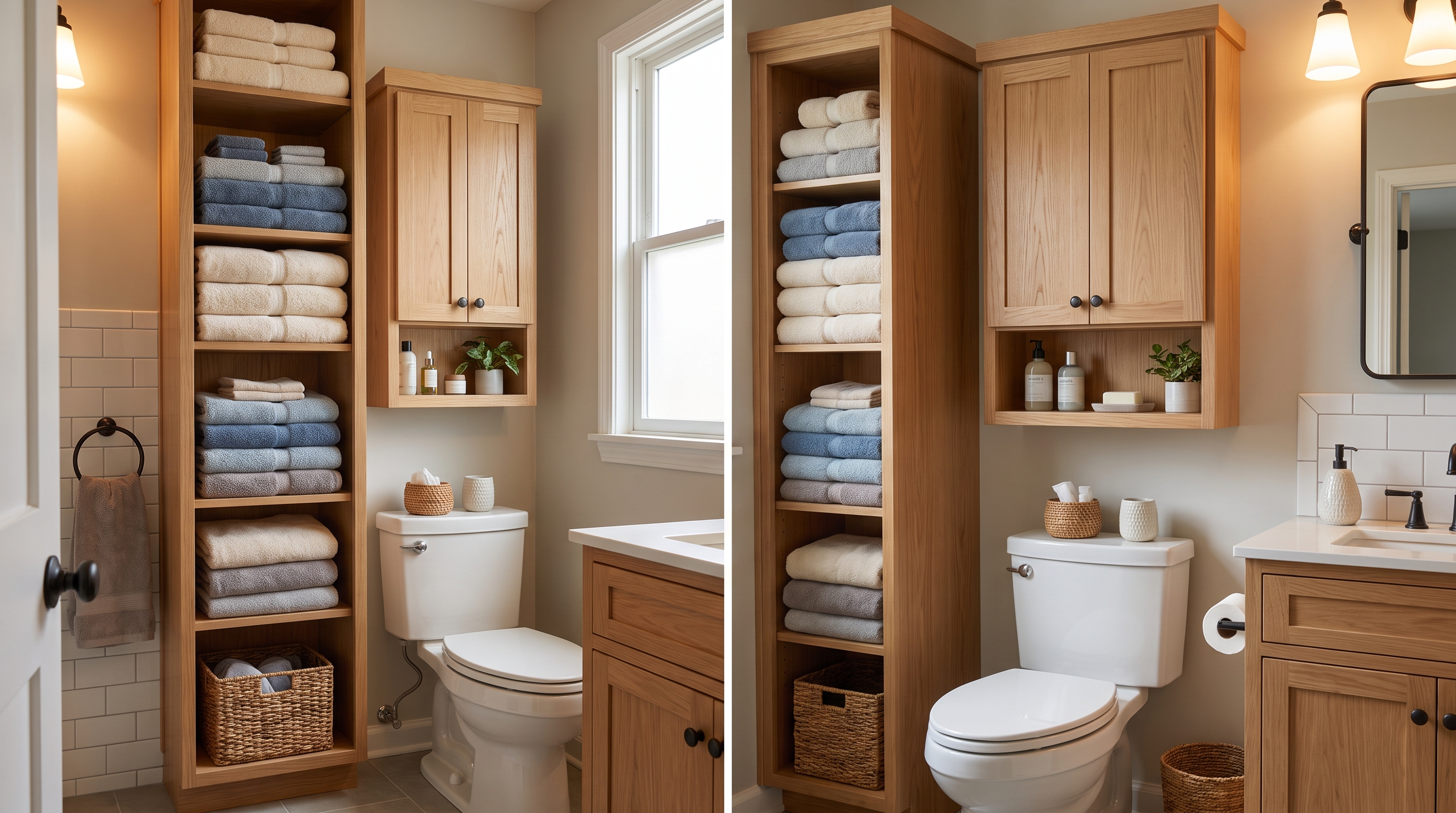
When the floor is full, go up. Vertical storage is where small bathrooms win back capacity.
A linen tower is a tall, narrow cabinet. Twelve to 24 inches wide, running most of the way to the ceiling. It costs $400 to $1,800 depending on whether it's stock MDF or solid wood, and it holds more than you'd guess from the footprint. For a bigger family in South Hill or Graham, a linen tower usually beats trying to cram every towel into vanity drawers.
Over-toilet storage puts the dead space above the tank to work. A freestanding étagère runs $150 to $600. A built-in cabinet that matches your vanity finish runs $800 to $1,800. The built-in looks sharper and doesn't wobble, but the freestanding version is a fast, cheap win in a rental or a guest bath.
### Open shelving looks great in photos, but read this first
Open shelves and floating shelves are all over the design feeds right now, usually paired with matte black or brass brackets. They look clean. Federal Brace and similar concealed-bracket sets run $40 to $120 per shelf.
But I give every client the same honest warning. Open shelving only works if your ventilation is solid. In a bathroom with a weak or missing exhaust fan, open shelves grow mildew on the towels and stored items within months. Our humidity is relentless. If your fan already struggles, closed cabinetry is the safer call until the fan and duct get fixed.
That ties straight into ventilation, which I treat as non-negotiable in any PNW bathroom. Washington code wants a fan ducted to the exterior, not dumped into the attic where it rots the framing. Get the air moving first. Then decide if open shelving is a smart look or a mold farm.
- Linen tower: $400 to $1,800, best for families and towel storage
- Over-toilet built-in: $800 to $1,800, uses dead space above the tank
- Floating shelf set: $40 to $120 per shelf, only with good ventilation
- Pull-out vanity organizer (Rev-A-Shelf): $250 to $600, great for the narrow gap beside a vanity
## A South Hill Project: Turning a Closet Into a Full Storage Wall
Let me give you a real one. A family in South Hill called me last spring. Their primary bath was a tight 1990s layout with a single-sink vanity, no linen storage, and a shallow reach-in closet on the shared wall that nobody used right. Coats and junk. They were drowning in towels and had bottles stacked on the toilet tank.
We borrowed that closet. Instead of adding square footage, I converted the closet depth into a built-in storage wall for the bathroom. Floor-to-ceiling cabinetry and open-and-closed shelving on the old closet footprint. We kept the plumbing exactly where it was, so no drain relocation and no slab work.
Here's what went in:
- A floor-to-ceiling built-in storage wall on the converted closet (cabinetry and shelving)
- A new 48-inch vanity with a drawer bank and moisture-resistant plywood boxes
- A recessed niche in the shower and a second recessed niche by the vanity for daily items
- A recessed medicine cabinet on the interior wall above one sink
- LED strip lighting in the display niche
Total project cost came in at $11,800. Timeline was about three weeks from demo to final walk-through, since we weren't moving any plumbing. The storage wall alone, the cabinetry and shelving, ran right around $4,100 of that. The family went from zero linen storage to more than they could fill.
That's the move I reach for most in older Pierce County homes. Borrowing an adjacent closet beats a true addition on cost-to-value every time, because you skip the foundation and framing work that an addition demands. For a sense of where a storage-focused remodel fits in the bigger picture, my full [bathroom remodel cost guide for Puyallup](/blogs/bathroom-remodel-cost-puyallup-wa/) breaks down every scope from a cosmetic refresh to a high-end gut.
> **Pierce County tip:** Many older local homes sit on crawlspaces, not slabs. That makes it easier and cheaper to add a floor-mounted linen tower or extend a vanity footprint than homeowners expect. Ask your contractor what's under your floor before you rule out floor storage.
## What Bathroom Storage Costs in Pierce County (2026)
Here's a clean reference for what I'm quoting on storage pieces right now. These are installed numbers in the Puyallup and greater South Sound market.
| Storage Element | Installed Cost |
|---|---|
| Recessed niche (during open-wall remodel) | $300 - $800 |
| Recessed niche (cut into finished wall) | $900 - $1,800 |
| Surface-mount medicine cabinet | $150 - $500 |
| Recessed medicine cabinet | $400 - $900 |
| Linen tower / floor cabinet | $400 - $1,800 |
| Over-toilet storage (freestanding to built-in) | $150 - $1,800 |
| Pull-out vanity organizer column | $250 - $600 |
| Semi-custom vanity with drawers | $1,200 - $3,500 |
| Shop-built custom vanity | $3,500 - $7,000+ |
| Closet-to-storage-wall conversion | $2,500 - $6,000 |
A few notes on where you land in those ranges. Material drives most of it. Stock MDF sits at the bottom, solid wood and moisture-resistant plywood sit higher. Labor on recessed work depends entirely on what's hiding in the wall. And custom cabinetry carries a lead time, so order early. The mid-range vanity lines I spec locally, like Fairmont Designs and James Martin, run one to two weeks through Tacoma and Fife suppliers, while fully custom shop work can take six to eight.
If you're weighing storage against other upgrades for resale, the data is clear that smart, built-in storage reads as quality to buyers. I covered the highest-return moves in my piece on the [best bathroom upgrades for resale value](/blogs/best-bathroom-remodeling-ideas/), and storage that keeps counters clear photographs well in a listing.
## Planning Storage Without Breaking Code or Clearances
One mistake I fix more than any other: homeowners who maximize storage and forget they still have to move through the room. You oversize a linen tower or push a vanity out too far, and suddenly the door won't swing or there's no legal clearance at the toilet.
Code sets minimums for a reason. You generally need about 21 inches of clear floor space in front of a fixture, and roughly 15 inches from the centerline of the toilet to any obstruction. A storage piece that violates that fails inspection and makes the room miserable to use.
So I plan storage and clearances together, not one after the other. Here are the questions I want answered before anyone orders a cabinet.
- [ ] Does the door still swing fully with this storage in place?
- [ ] Is there 21 inches of clear floor in front of the vanity and toilet?
- [ ] Is the toilet centerline at least 15 inches from the nearest obstruction?
- [ ] Is the exhaust fan strong enough and ducted outside before adding open shelving?
- [ ] Are recessed niches on interior walls, clear of plumbing and wiring?
- [ ] Are the cabinet boxes moisture-resistant plywood, not particleboard?
If you're planning storage as part of a bathroom you'll age into, pair these ideas with grab-ready blocking and easy-reach drawers. My guide on an [aging-in-place bathroom remodel](/blogs/aging-in-place-bathroom-remodel/) walks through how to design storage you can still reach in 20 years.
I serve homeowners across the South Sound on projects like these. I've built storage-focused bathroom remodels for clients in [Tacoma](/bathroom-remodeling-tacoma-wa/), [Sumner](/bathroom-remodeling-sumner-wa/), [Bonney Lake](/bathroom-remodelers-in-bonney-lake-wa/), [Edgewood](/bathroom-remodeling-edgewood-wa/), and [South Hill](/bathroom-remodeling-south-hill-wa/). The full menu of what I offer lives on my [bathroom remodeling in Puyallup](/bathroom-remodeling-puyallup-wa/) page.
## Bathroom Storage Questions I Hear the Most
**Our bathroom is tiny. Where do we even put storage?**
Go vertical and go into the walls. In a 5x7 bath, the floor is your scarcest resource, so I reach for tall narrow linen towers, over-toilet cabinets, and recessed niches first. A pull-out column in the gap beside the vanity adds real capacity in a space most people waste. Floor cabinets come last, only if there's room to spare.
**Will open shelving get moldy in our humid bathroom?**
It can, and it will if your ventilation is weak. Open shelving works fine with a strong exhaust fan ducted to the exterior. Without that, towels and stored items grow mildew within months in our climate. If your fan already struggles, go with closed cabinetry until the fan and duct get sorted out.
**Can you add a recessed medicine cabinet to any wall?**
Interior walls, yes, as long as we scope for plumbing and wiring first. Exterior walls, I avoid it. Those walls carry insulation and a vapor barrier in Pierce County homes, and recessing a cabinet into them compromises both. On an exterior wall I'll use a surface-mount cabinet instead.
**What's the cheapest way to add storage to a bathroom I'm not fully remodeling?**
Swap a pedestal sink or a shallow vanity for a slightly deeper vanity with a drawer bank, without touching the plumbing locations. That's often the highest-return small fix I do. Add a freestanding over-toilet unit for $150 to $600 and a pull-out organizer, and you've solved most of the clutter for well under a full remodel.
**Should we do a linen closet or more vanity drawers?**
It depends on household size more than style. A bigger family usually needs a dedicated linen tower or closet, because vanity drawers alone can't hold the towels and sheets. A couple or a single person can often get by with a well-designed drawer bank and skip the separate linen storage.
## Let's Build Storage That Actually Fits Your Home
If your counters are covered and you're stacking towels on the toilet tank, you don't need a bigger bathroom. You need storage planned by someone who's built it into dozens of older Pierce County homes and knows what's hiding in those walls.
Call me at **(253) 392-9266** or reach out through my [contact page](/contact-us/). I'll walk your space, measure the cavities and clearances, and give you an honest bid on storage that lasts. No change-order games, no particleboard boxes that swell in two winters. I treat every bathroom like it's my own mom's house, because that's the only way I know how to build.
*Brad Zemke, Owner*
*Pacific Remodeling LLC*
*Puyallup, WA*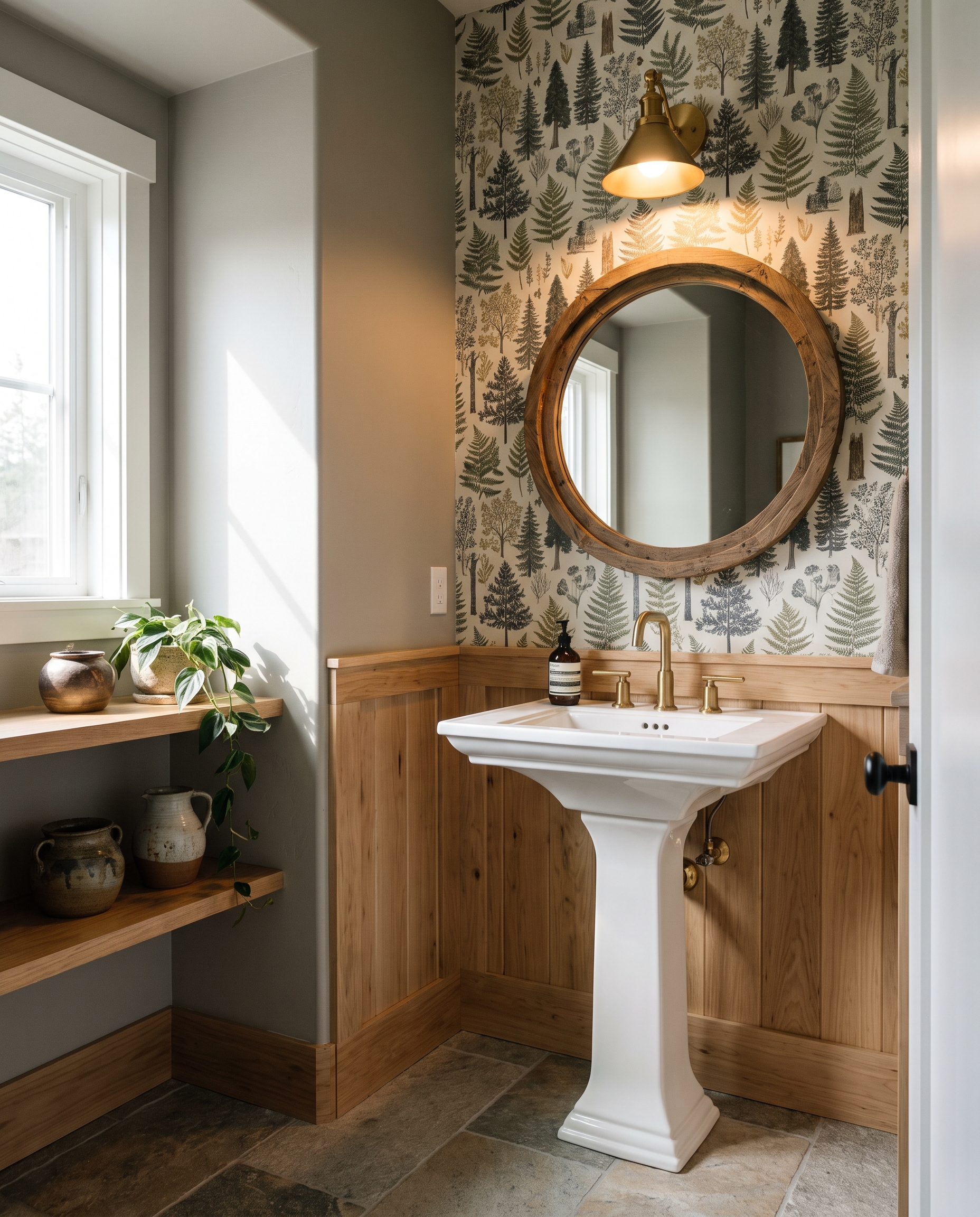
Bathroom Storage Solutions: Smart Ideas That Fit Puyallup Homes

Ready to Start Your Project?
Contact Pacific Remodeling for a free, no-obligation estimate on your kitchen or bathroom remodeling project.
Get Your Free EstimateYou Might Also Like
October 11, 2026
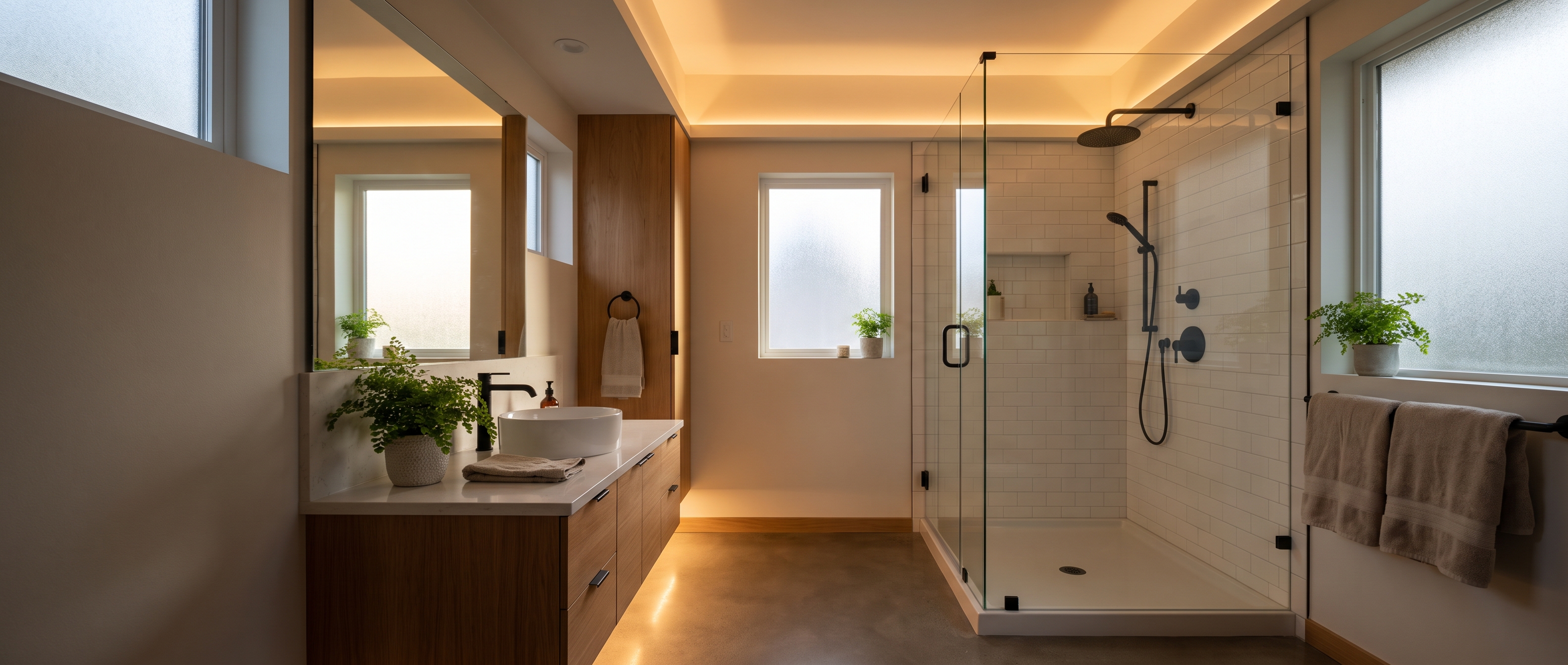
Small Bathroom Remodel Ideas That Make a 5x7 Feel Twice the Size
A full small bathroom remodel in Puyallup runs $12,000 to $22,000 for a 5x7 room. Here are the design ideas I use to make a tight space feel bigger, plus the exact numbers behind each one.
October 5, 2026
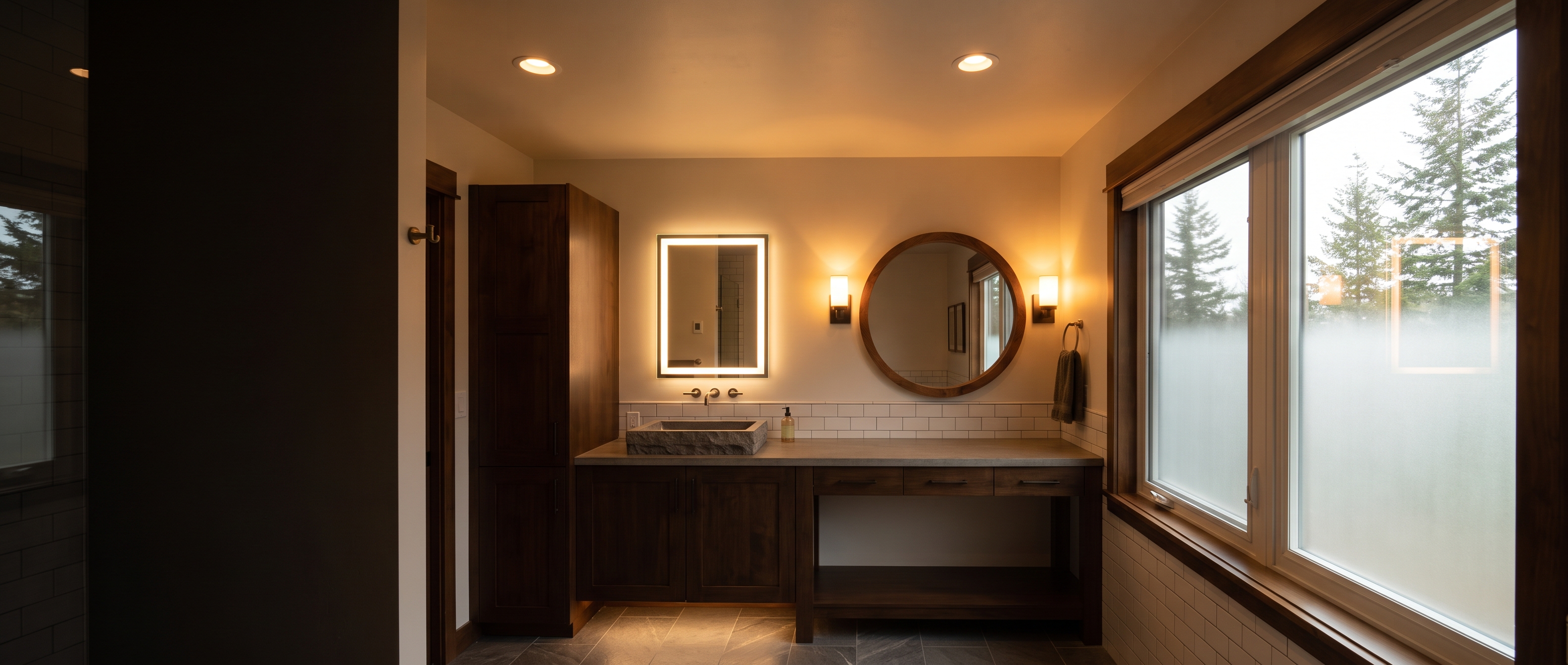
Bathroom Lighting Ideas and Costs: What I Install in Puyallup Homes
A full bathroom lighting overhaul in Puyallup runs $1,800 to $4,500 for a standard bath. I'll show you where every dollar goes and the one layout mistake I fix most often.

September 10, 2026
Bathroom Tile Ideas 2026: What I'm Installing in Puyallup Homes
The bathroom tile ideas driving 2026 are large-format porcelain, warm matte finishes, and one bold accent wall. I've set all of them in Pierce County homes, and installed tile runs $12 to $45 a square foot depending on what you pick.