A full kitchen appliance upgrade in Pierce County runs $3,200 to $14,500 for a mid-range suite and $20,000 to $88,000+ if you go premium or luxury. The single appliance that gives you the biggest bang for your dollar is a new dishwasher. I’m not guessing. I’ve watched buyers walk through kitchens I’ve remodeled in Puyallup, Sumner, and Bonney Lake, and the dishwasher and range are the two things they open first.
I’m Brad Zemke, owner of Pacific Remodeling here in Puyallup. I’ve spent 20+ years in the trades, started this business in 2018, and I’m a third-generation carpenter. This kitchen appliance upgrade guide covers real costs, real brands, and real advice from someone who installs these products in Pierce County homes every week.
What a Kitchen Appliance Upgrade Actually Costs in 2026
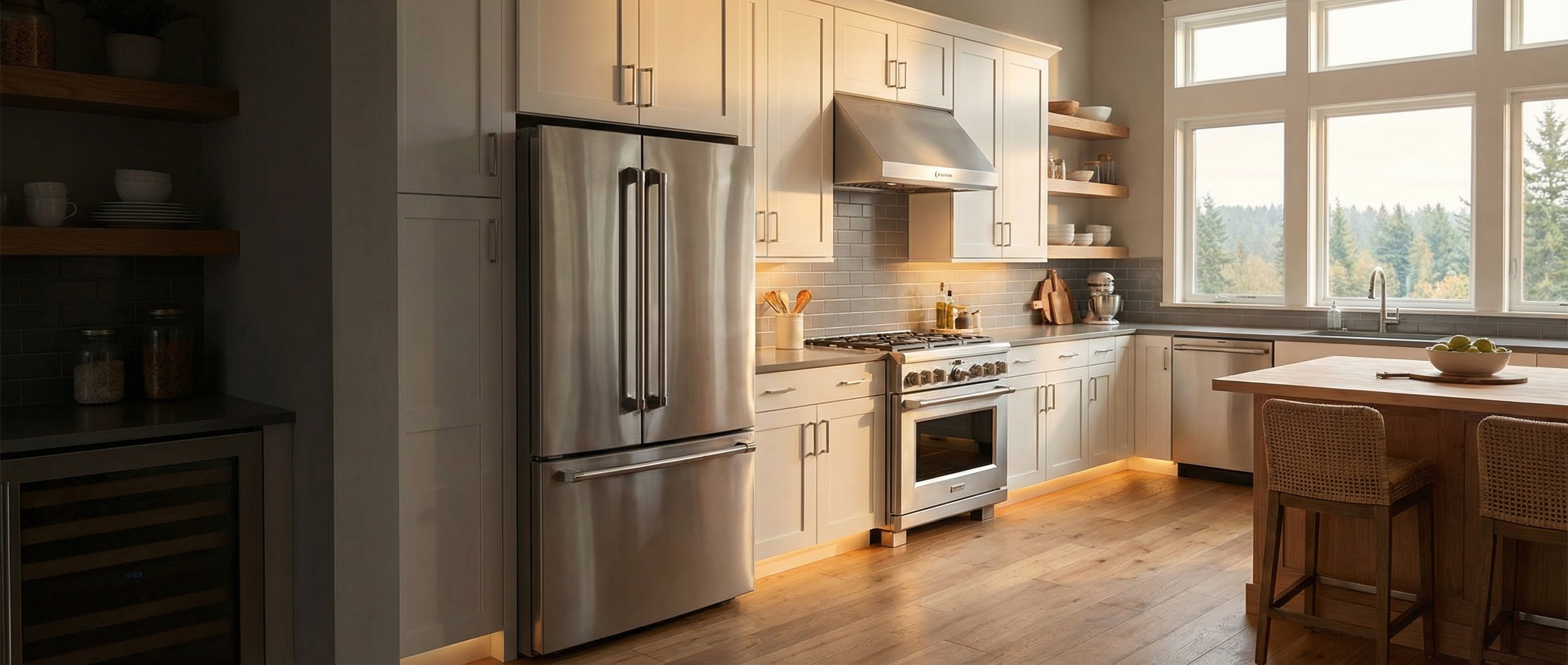
Before you start browsing showrooms or scrolling Samsung’s website, here’s the reality check. These numbers include the appliance and standard installation labor in Pierce County.
| Appliance | Budget | Mid-Range | Premium | Luxury |
|---|---|---|---|---|
| Refrigerator (French door) | $1,200 - $1,800 | $2,000 - $3,500 | $4,000 - $7,000 | $8,000 - $20,000+ |
| Range (30” slide-in) | $700 - $1,200 | $1,400 - $2,500 | $3,000 - $5,500 | $8,000 - $18,000+ |
| Dishwasher | $600 - $1,000 | $1,100 - $1,800 | $2,000 - $3,500 | $4,000 - $8,000 |
| Range hood | $300 - $600 | $700 - $1,500 | $1,800 - $4,000 | $4,500 - $10,000+ |
| Over-the-range microwave | $300 - $500 | $550 - $900 | $1,000 - $1,800 | N/A |
| Microwave drawer | N/A | $900 - $1,400 | $1,500 - $2,500 | $2,800 - $4,000 |
Full suite replacement costs (installed, Pierce County):
- Budget suite (fridge, range, dishwasher, microwave): $3,200 - $6,000
- Mid-range suite: $7,800 - $14,500
- Premium suite: $20,000 - $38,000
- Luxury/Pro suite: $44,000 - $88,000+
Those Pierce County numbers run about 8-15% above national averages. Licensed contractors here carry Washington L&I insurance, and that overhead is real. Standard appliance installation labor runs $150 to $400 per appliance for a straight swap. Gas line work requires a WA-licensed plumber and adds $300 to $700 per appliance. New electrical circuits for induction or upgraded ranges add $400 to $900 per circuit.
If you’re planning a full kitchen remodel alongside the appliance upgrade, you can often save on installation labor by bundling everything into one project.
Should You Replace All Appliances at Once or One at a Time?
This is the question I hear most often during consultations. The answer depends on your budget, your timeline, and whether you’re selling soon.
The Case for Replacing Everything at Once
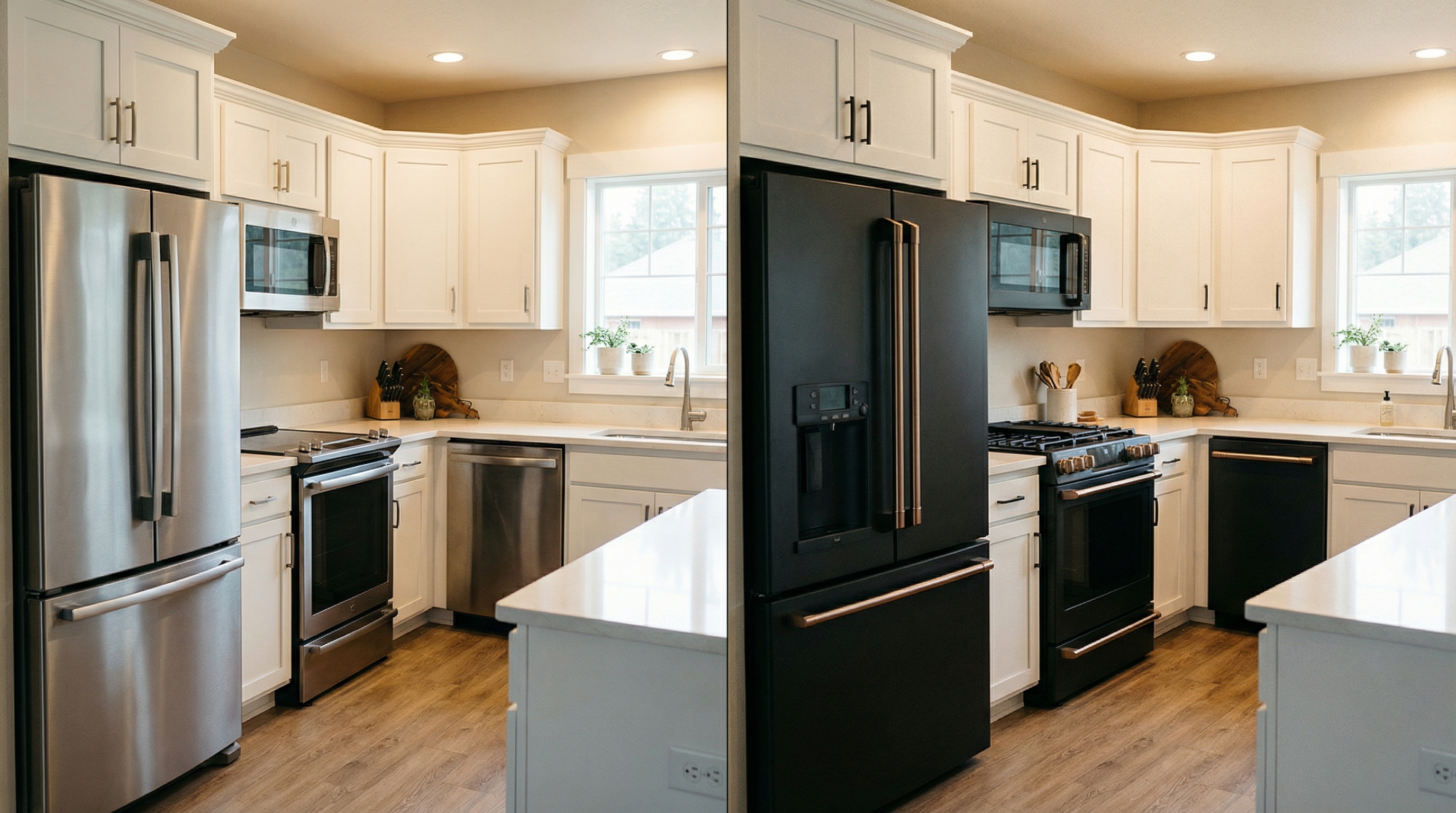
Manufacturers offer suite discounts of 10-20% when you buy a matching set. Samsung, LG, GE, Cafe, and Bosch all run these promotions throughout the year, and they stack with holiday sales. On a $10,000 mid-range suite, that’s $1,000 to $2,000 in savings you leave on the table by buying piecemeal.
Matching finishes matter more than people realize. “Stainless steel” is not one color. Bosch stainless runs cooler than GE stainless. Samsung stainless has a different sheen than Whirlpool. Buy your fridge from one brand and your dishwasher from another, and you’ll notice the mismatch every time you walk into the kitchen. Matte finishes from Cafe or Samsung Bespoke avoid this problem entirely, which is one reason they’re gaining popularity in Pierce County remodels.
You also save on installation labor. One electrician visit to handle all the hookups costs less than three separate visits over two years.
The Case for Replacing One at a Time
Not everyone has $8,000 to $14,000 sitting in the budget. That’s real. If you need to stagger, here’s the order I recommend based on the impact each appliance has on your daily life and your home’s value:
- Dishwasher. Biggest quality-of-life improvement per dollar. A Bosch 500 series at $900 to $1,100 transforms the kitchen experience. Quiet, clean, reliable.
- Range. A slide-in range gives your kitchen a built-in look that a freestanding range can’t match. The $300 to $800 premium over freestanding is worth it.
- Refrigerator. Counter-depth models make small Pierce County kitchens feel larger. This is the most visible appliance in the room.
- Range hood. Most people keep the builder-grade hood far too long. An undersized hood with weak airflow affects indoor air quality, especially in newer PNW homes with tighter building envelopes.
- Microwave. Last priority. It has the least impact on daily function and resale.
If you’re selling in 1-3 years: A new dishwasher and slide-in range give you the highest buyer impact per dollar in the $450K to $650K Pierce County market. Full luxury suites in this price tier risk over-improving.
The Gas vs. Induction Debate (And Why It Matters in Washington)
This conversation has changed in the last two years, and most homeowners I talk to don’t know about the financial incentives available right now.
| Factor | Gas Range | Electric Range | Induction Range |
|---|---|---|---|
| Appliance cost (30”, mid-range) | $1,400 - $3,000 | $1,000 - $2,500 | $1,800 - $3,500 |
| Installation (existing hookup) | $200 - $400 | $150 - $300 | $150 - $300 |
| New gas line (if needed) | +$800 - $2,500 | N/A | N/A |
| New 240V circuit (if needed) | N/A | +$400 - $800 | +$400 - $800 |
| PSE monthly cooking cost | ~$12 - $18/mo | ~$25 - $40/mo | ~$20 - $30/mo |
| WA State rebates (2026) | None | Possible | Up to $840 |
Here’s the deal. Washington State and Puget Sound Energy offer rebates for switching from gas to induction. PSE rebates for induction ranges reach up to $840. Federal IRA tax credits cover 30% up to $840 on qualifying models. Stack those together and an induction range that costs $2,200 might net out to $1,200 after rebates. That puts it below a comparable gas range.
I installed a GE Profile induction range in a South Hill kitchen last fall. The homeowners had cooked on gas for 15 years and were skeptical. Three months later, the wife told me she’d never go back. Water boils in half the time. The cooktop surface stays cool enough to touch 30 seconds after you turn it off. No combustion byproducts in the air, which matters in these tighter PNW homes built to Washington’s strict energy code.
The one thing people forget: induction requires magnetic-bottom cookware. Grab a fridge magnet. If it sticks to the bottom of your pot, the pot works on induction. If it doesn’t, you’re buying new cookware. Budget $200 to $600 for a set from Tramontina, All-Clad, or Made In.
If your home doesn’t have a 240V outlet behind the range (common if you’re converting from gas), you’ll need an electrician to run a new 50-amp circuit. That costs $500 to $1,200 in Pierce County depending on the distance from your panel to the kitchen.
Appliance Brands That Hold Up (And the Ones I’ve Seen Fail)
I don’t sell appliances. I install them. That means I see what breaks, what lasts, and what homeowners regret buying two years later. Here’s my honest take on the brands I encounter most often in Pierce County kitchens.
Dishwashers
Bosch owns this category. The 800 series (SHPM88Z75N, around $1,100 to $1,400) is the single most-requested dishwasher by my remodel clients. At 42 dBA, you can run it during dinner and forget it’s on. The 500 series ($900 to $1,100) is nearly as good and represents the best value in the market.
Miele costs more ($1,800 to $3,800) but builds dishwashers that genuinely last 20 years. I’ve seen Miele units from the mid-2000s still running strong. If you’re staying in your home long-term, the math works.
What I’d skip: LG and Samsung dishwashers photograph well and the smart features sound impressive, but I’ve seen more service calls on these brands than Bosch or Whirlpool in the last three years. A dishwasher that needs a technician in year two isn’t a deal at any price.
Ranges and Cooktops
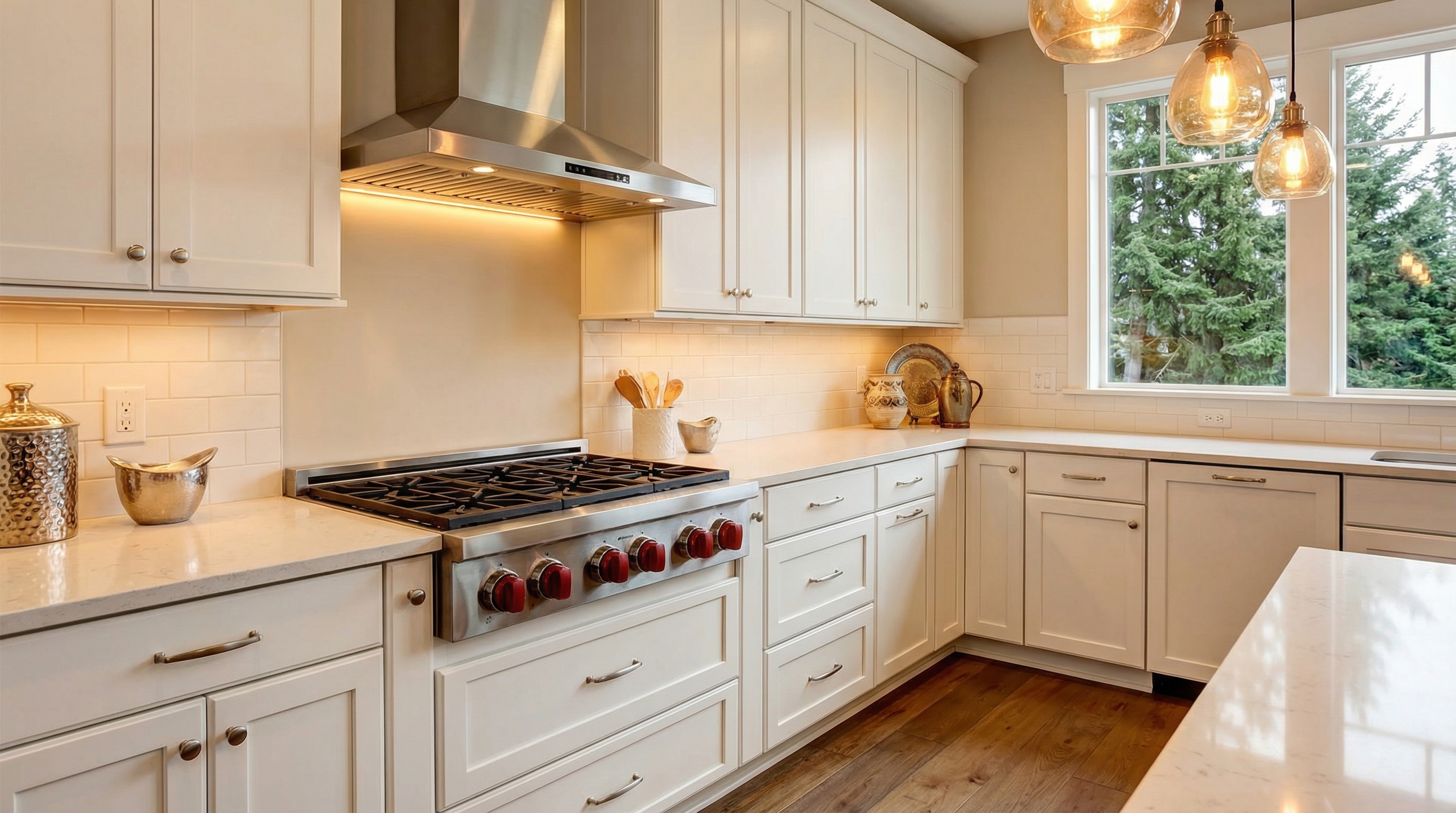
For mid-range gas, the Cafe CGS700P ($1,800 to $2,200) with its matte finish and high-BTU center burner is a strong pick. For induction, the GE Profile PHS930 ($2,000 to $2,500) is the best mid-range option I’ve installed, and it qualifies for PSE rebates.
If you want the pro-style look without the pro price, Thor Kitchen (HRG3080U, $1,500 to $2,000) and Zline (SGRS-30, $2,200 to $2,800) offer commercial aesthetics at a fraction of Wolf or Viking pricing. I’ve put several of these in Puyallup and Edgewood kitchens. They look great and cook well, though the fit and finish isn’t Wolf-level.
At the luxury tier, Wolf and BlueStar are the gold standard. A Wolf GR364 at $8,500 to $10,000 is a lifetime appliance. But in a $525,000 Puyallup home, it’s likely over-improvement. I save that recommendation for homes in the $700K+ range.
Refrigerators
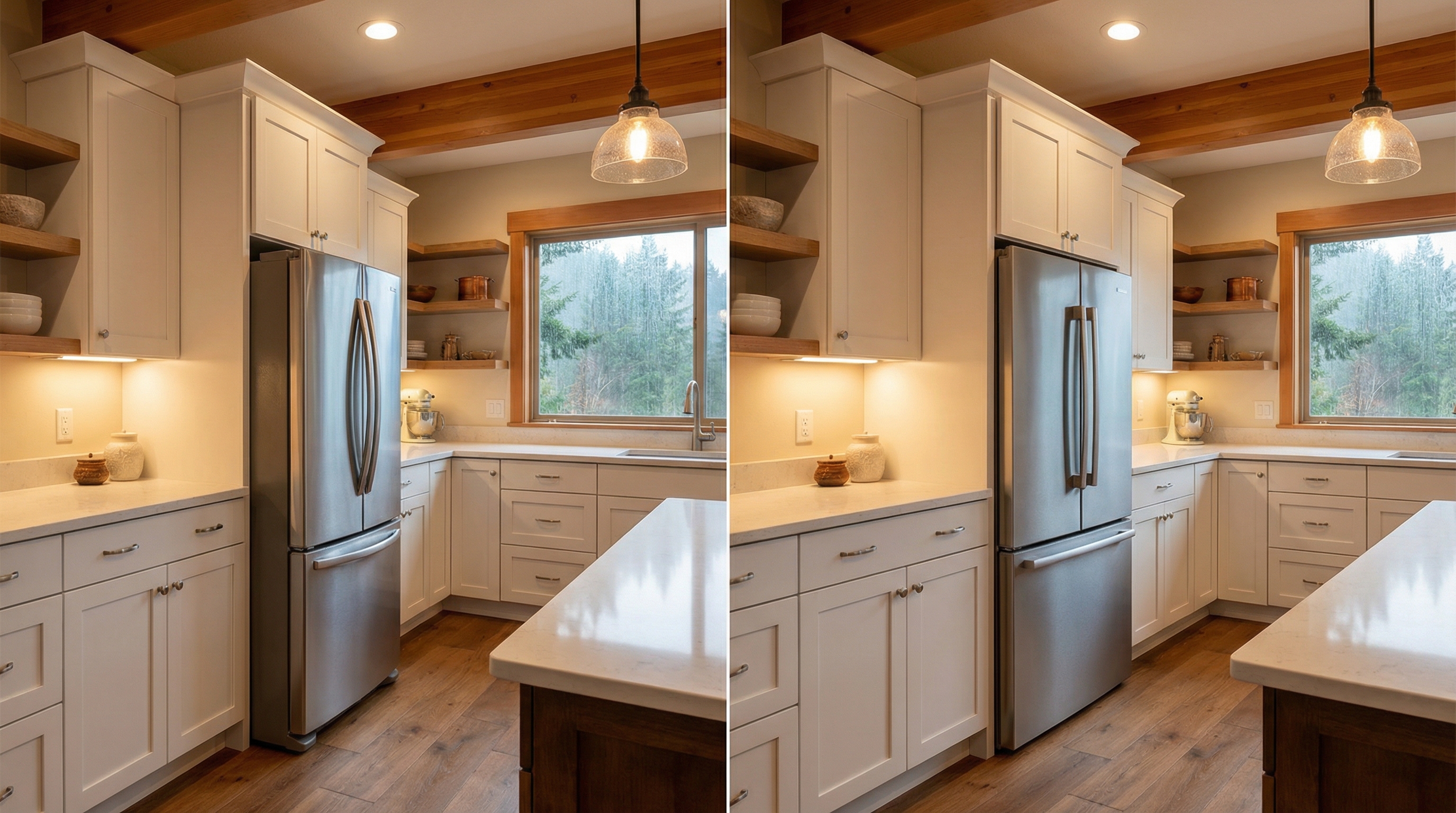
Counter-depth refrigerators are the biggest upgrade in appearance per dollar. A standard-depth fridge sticks out 6 to 8 inches past your counters. Counter-depth sits flush. The kitchen instantly looks more intentional.
My mid-range picks:
- KitchenAid KRFC704FSS ($2,800 - $3,500): Counter-depth, reliable, strong ice maker
- LG LRFVS3006S InstaView ($2,200 - $2,800): Door-in-door reduces cold air loss
- Cafe CYE22TP4MW2 ($3,200 - $4,000): Matte white or black, high-design look
For luxury, Sub-Zero ($9,500 to $13,000 for a built-in 36”) is the industry benchmark. These fridges last 20+ years with proper maintenance. Ferguson Bath, Kitchen & Lighting Gallery in Tacoma is the closest authorized dealer for Sub-Zero in Pierce County.
Range Hoods: The Most Neglected Appliance in the Kitchen
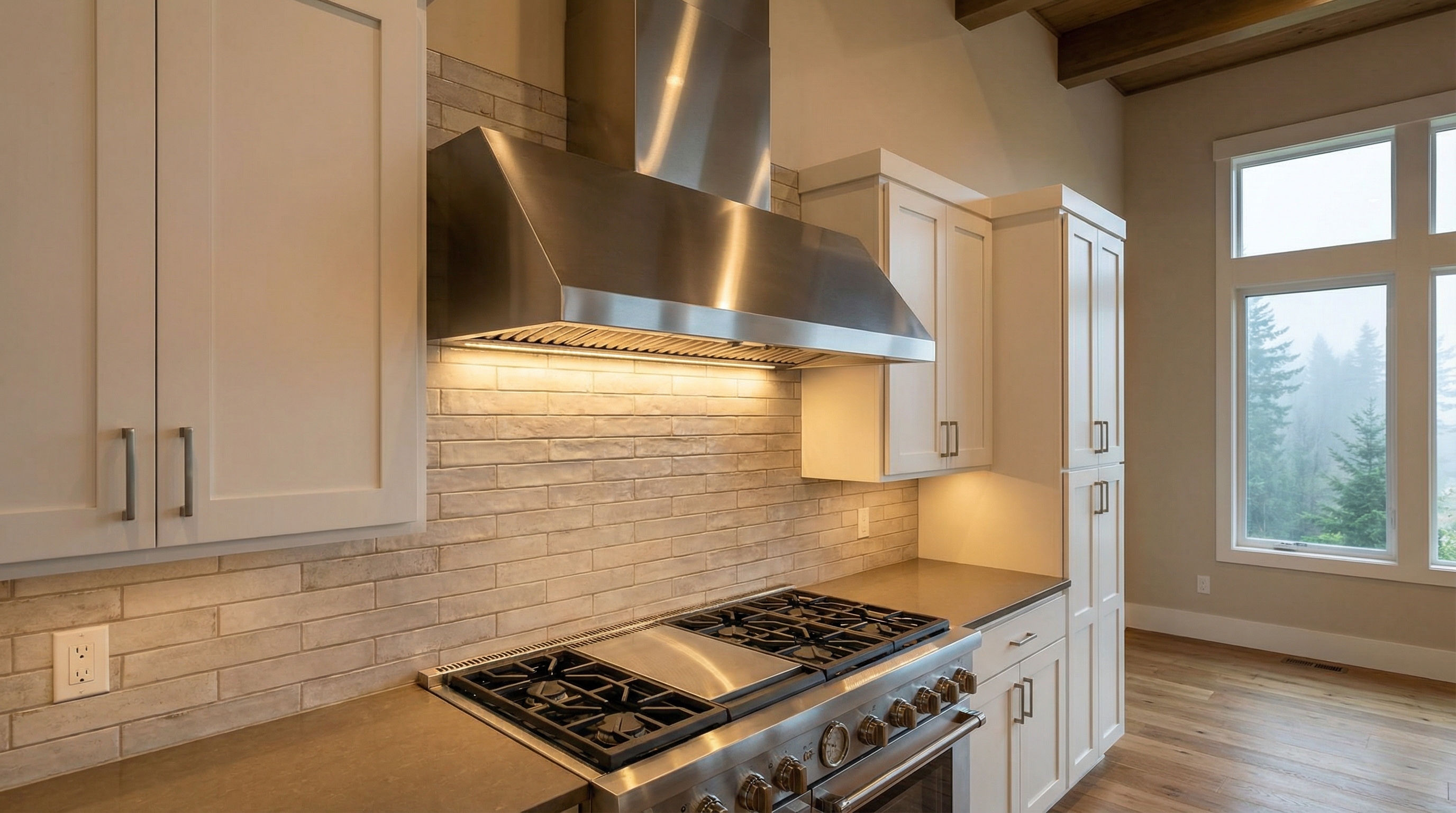
I can’t tell you how many kitchens I walk into where the homeowner spent $3,000 on a beautiful range and left the builder-grade 300 CFM hood above it. That’s like putting racing tires on a car with no brakes.
The CFM rule: Gas ranges need minimum 100 CFM per 10,000 BTU. If your pro-style range puts out 60,000 BTU, you need at least 600 CFM. Pacific Northwest homes built after 2012 follow stricter energy codes, which means tighter building envelopes, which means combustion byproducts from gas cooking concentrate faster. Size your hood up 20% from the minimum.
Good mid-range options:
- Zephyr Arc AK2200BS ($500 - $800): Slim wall-mount, 640 CFM, popular in remodels
- Broan Elite E6430SS ($600 - $900): 400 CFM with Heat Sentry auto-on
- Kobe IN2636SQBF ($1,200 - $1,800): 1,200 CFM for pro-style ranges
If you’re upgrading your range, budget for the hood too. I talk more about the electrical side of kitchen upgrades in the kitchen lighting upgrade guide.
9 Appliance Upgrade Mistakes I Watch Homeowners Make
I’ve seen every one of these in Pierce County kitchens. Some cost a few hundred dollars to fix. Others require ripping out cabinets.
1. Buying Appliances Before Cabinet Dimensions Are Confirmed
This one makes my stomach drop. A homeowner gets excited by a holiday sale, buys a 36-inch range, and then finds out their cabinet opening is 30 inches. Or they buy a counter-depth fridge without measuring from the floor to the bottom of the upper cabinet, and the door hinge won’t clear.
Measure first. Buy second. Standard rough opening for a 30-inch range is 30” wide by 25” deep minimum. Counter-depth fridges need 25 to 27 inches of depth clearance, and you need 1 to 2 inches above for the door hinge swing.
2. Ignoring Electrical Panel Capacity
This is the big one in older Pierce County homes. A 1960s ranch in Spanaway or Lakewood might have a 100-amp or even 60-amp panel. A modern kitchen with an induction range (40-50 amps), dishwasher (20 amps), refrigerator (15-20 amps), and microwave (20 amps) can blow past that capacity fast.
A panel upgrade to 200 amps runs $2,500 to $5,000 installed in Pierce County. Your electrician should assess panel capacity at the first site visit, not the week you’re ready to install. I’ve covered permits and electrical requirements in detail if you want the full picture.
3. Buying a Suite for Looks Instead of Performance
Matching suites photograph beautifully. The discount is real. But LG and Samsung suites have higher service call rates than Bosch, Miele, or Whirlpool. If performance matters more than a perfectly matched finish, mix brands. A Bosch dishwasher, a GE Profile range, and a KitchenAid fridge will outperform most single-brand suites.
4. Undersizing the Range Hood
Covered above, but it bears repeating. A beautiful cooktop with an undersized hood is a health and comfort problem, not just an aesthetic one.
5. Replacing Appliances Before Refinishing Cabinets
Sequence matters. New stainless appliances against grimy, dated cabinets look worse than the old appliances did. If you’re upgrading both, do the cabinets first. I wrote a full comparison of cabinet refacing vs. replacing if you’re weighing that decision.
The right order: demo, paint or refinish cabinets, install appliances, add hardware.
6. Skipping the Rebate Research
PSE rebates plus federal IRA credits can offset $500 to $1,500 on qualifying appliances. ENERGY STAR dishwashers qualify for $50 to $100 PSE rebates. Induction ranges qualify for up to $840. These programs update quarterly, so check PSE’s website before you buy. As a contractor, I always walk my clients through the available rebates. It builds goodwill, and it’s the right thing to do.
7. Not Planning for Gas-to-Electric Conversion Costs
Switching from a gas range to induction isn’t just swapping appliances. You need a new 240V/50A circuit from the panel to the kitchen ($500 to $1,200). If your panel needs upgrading, add $2,500 to $5,000 on top. I’ve had homeowners budget $2,500 for an induction range and end up spending $5,000 once the electrical work was included.
8. Forgetting About Refrigerator Placement Near Exterior Walls
Older Pierce County homes often have the fridge against an uninsulated exterior wall. Thermal bridging from that cold wall makes the compressor work harder, especially during our wet, cold winters. If you can’t move the fridge, add insulated panels or maintain a 2-inch air gap behind the unit.
9. Buying Display Models Without Checking the Warranty
Display model pricing is compelling, often 20-40% off. Both Ferguson and Best Buy sell display units. But some display appliances come with voided or shortened warranties. Ask explicitly before you buy. A $300 discount that costs you a $1,200 compressor repair in year three is no deal at all.
A Real Project: Appliance Upgrade on South Hill
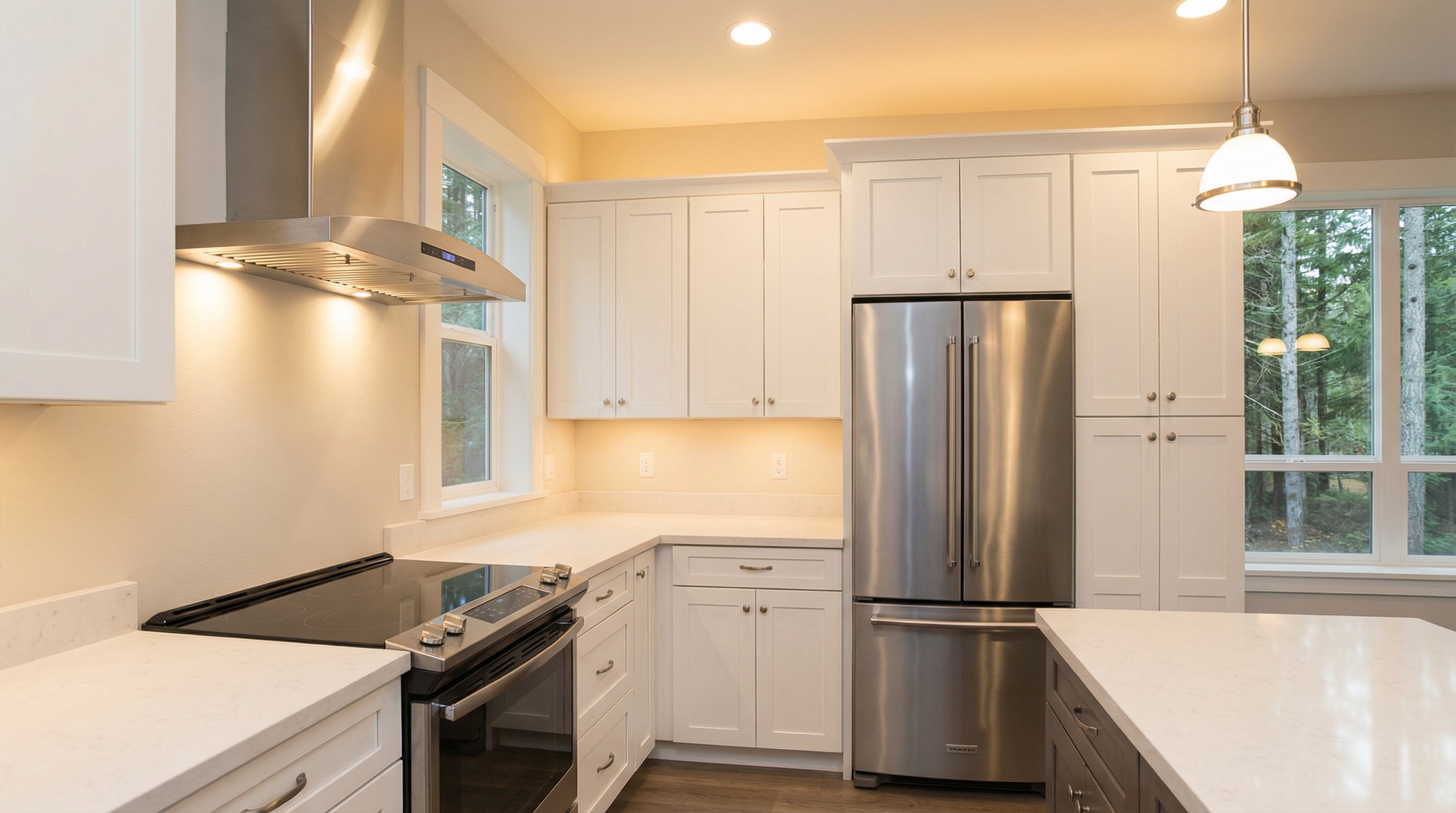
Last October, I completed a full kitchen remodel for a family on South Hill in a 2006-built home. The kitchen was about 160 square feet with the original builder-grade appliances, all 18 years old.
Here’s what we installed:
- Range: GE Profile PHS930 30” slide-in induction, $2,350
- Refrigerator: KitchenAid KRFC704FSS counter-depth, $3,100
- Dishwasher: Bosch 800 series SHPM88Z75N, $1,250
- Range hood: Zephyr Arc 30” wall-mount, $680
- Microwave: GE Profile countertop (moved off the range to free up hood space), $280
- Electrical work: New 50A circuit for induction range, two new 20A circuits for dishwasher and microwave, $1,650
- Installation labor: $850
Total appliance upgrade cost: $10,160
The homeowners received $840 from PSE’s induction rebate and $75 for the ENERGY STAR dishwasher. Net cost after rebates: $9,245.
Timeline from ordering to completed installation: 3 weeks. The induction range was in stock at the Puyallup Home Depot. The Bosch dishwasher took 10 days to arrive. The KitchenAid fridge needed a special order for the counter-depth configuration, which added a week.
That family had cooked on a gas range with a cheap over-the-range microwave acting as the “hood” for almost two decades. The difference in their kitchen’s air quality, noise level, and cooking performance was night and day.
Your Kitchen Appliance Upgrade Checklist
Before you spend a dollar, walk through this list. I hand something similar to every client during our initial consultation.
- Measure all appliance openings (width, depth, height to upper cabinets)
- Check your electrical panel amperage (look for the main breaker rating)
- Identify your current fuel type (gas, electric, or propane)
- Decide if you’re switching fuel types (gas to induction requires new circuit)
- Set a realistic budget including installation and electrical/plumbing work
- Research current PSE and federal rebates for your chosen appliances
- Visit appliances in person (stainless tones vary between brands)
- Bring your cabinet hardware or faucet to the showroom for finish matching
- Ask about delivery lead times before committing to a project start date
- Confirm warranty terms, especially on display or clearance models
If you’re combining an appliance upgrade with a broader remodel, the kitchen renovation planning guide covers the full process from design through final inspection.
Frequently Asked Questions
Do I need permits to replace kitchen appliances in Pierce County?
A straight swap of the same appliance type on the same circuit or gas line typically does not require a permit. But the moment you change fuel types, add a new electrical circuit, or run a new gas line, you need permits. Switching from gas to induction requires an electrical permit ($85 to $150) for the new 240V circuit. Adding a gas appliance where none existed requires a gas line permit and a WA-licensed plumber. Panel upgrades require their own electrical permit. I’ve broken down the full permit process for Pierce County in a separate post.
What appliance upgrades add the most value when selling my home?
In the $450K to $650K Pierce County market, a new dishwasher and slide-in range give you the highest visual impact per dollar. Counter-depth refrigerators make kitchens feel larger in listing photos. Full luxury suites (Sub-Zero, Wolf, Miele) rarely pay back their cost in homes under $650K. That’s not a knock on those brands. It’s math. I wrote a deeper analysis on kitchen remodel upgrades that add value if you want the full breakdown by price tier.
Is it worth switching from gas to induction in 2026?
For most Pierce County homeowners, yes. Washington State is pushing toward 100% clean electricity by 2045, natural gas costs are rising, and the rebate stack ($840 PSE + up to $840 federal) makes the upfront cost difference minimal. Induction cooks faster, produces no combustion byproducts, and gives you precise temperature control that gas can’t match. The main cost to plan for is the new 240V circuit if you’re converting from gas.
Where should I buy appliances in Pierce County?
It depends on your tier. Home Depot and Lowe’s in Puyallup carry GE, Samsung, LG, and Frigidaire at competitive prices. Best Buy offers solid price-matching and includes haul-away. Costco in Puyallup runs strong LG and Samsung bundle deals with delivery included. For premium and luxury brands like Sub-Zero, Wolf, Miele, and Thermador, Ferguson Bath, Kitchen & Lighting Gallery in Tacoma is the go-to. Keep in mind that luxury brands can have 8 to 20 week lead times from Seattle distributors, so order early.
How long do kitchen appliances last?
Budget appliances: 8-12 years. Mid-range: 12-15 years. Premium brands like Bosch and KitchenAid: 15-20 years. Luxury brands like Sub-Zero and Miele: 20+ years with proper maintenance. If your current appliances are pushing 15 years and you’re planning any kind of kitchen remodel, replacing them now saves you the cost of a second installation later.
Also Serving Pierce County and Beyond
I’ve completed kitchen appliance upgrades and full remodels for homeowners across Pierce County, including Tacoma, Bonney Lake, Sumner, Edgewood, Lake Tapps, University Place, and Orting. Same standards, same pricing, same attention to detail regardless of zip code.
Ready to Upgrade Your Kitchen Appliances?
If you’re planning a kitchen appliance upgrade in Pierce County, I’d like to help you get it right the first time. I’ll walk through your kitchen, check your electrical panel, measure your openings, and give you an honest recommendation based on your budget and goals. No pressure. No sales pitch. Just straight answers from someone who’s done this work for over 20 years and treats every home like it’s my own family’s.
Call me at (253) 392-9266 or schedule a consultation online. I’ll get back to you within 24 hours.
Brad Zemke, Owner Pacific Remodeling LLC Puyallup, WA