Butcher block countertops cost $45 to $120 per square foot installed in the Puyallup area. A typical 40 square foot kitchen runs $1,800 to $4,800 in wood, against $6,600 to $9,200 in quartz. That’s the short version of butcher block countertops pros and cons: you save money and get a warm surface you can sand and refinish, but you sign up for oiling, trivets, and a constant fight with water at the sink.
I’m a third-generation carpenter with 20+ years in the trades, and I’ve completed more than 500 projects since starting Pacific Remodeling LLC in Puyallup in 2018. Stone is a fabricator’s material. Wood is a carpenter’s material, and it’s the one I grew up on.
Here’s how one kitchen client described working with me:
“I feel like I have a brand new kitchen and living and dining room. Every day I come downstairs I have a smile on my face looking at my new kitchen. He was always on time and left the job site clean when he left. I have plans to have him do more work at my house.”
Thomas R., Google review
Butcher Block Countertops Pros and Cons at a Glance
A butcher block countertop is a thick slab of hardwood strips that a shop glues together side by side. Here’s the quick list. The details follow.
The pros:
- Lower cost than stone. $45 to $120 per square foot installed, against $165 to $230 for quartz.
- Warmth. Wood softens a white kitchen in a way no stone can.
- Repairable. You can sand out scratches, knife marks, and many stains, then re-oil.
- Easy on dishes. A glass you set down hard has a better chance on wood than on granite.
- On-site fitting. A carpenter can cut, scribe, and fit it in your kitchen. No fabrication shop.
The cons:
- Water damage. Standing water swells, warps, and cracks wood, especially at the sink.
- Ongoing upkeep. You oil it monthly at first, then whenever water stops beading.
- Heat damage. A hot pan can leave a permanent scorch mark.
- Dents and scratches. Softer species like walnut and cherry show wear fast.
- Movement. Wood swells and shrinks with humidity, and a top that can’t move cracks.
Read that cons list twice. If you can live with every item on it, wood gives you a kitchen that feels like home. If two of them make you wince, buy quartz and sleep well.
What Do Butcher Block Countertops Cost in Puyallup?
Price sits at the top of every butcher block countertops pros and cons list, so start there. I priced every material below at my own installed rates for a 40 square foot kitchen. That’s a typical countertop size for the kitchens I work on around Pierce County.
| Material | Installed price per sq ft | Typical 40 sq ft kitchen | Ongoing care | Handles a sink well? |
|---|---|---|---|---|
| Laminate | $20-$65 | $800-$2,600 | Wipe and go | Mostly. Watch the seams. |
| Butcher block | $45-$120 | $1,800-$4,800 | Oil monthly at first, then as needed | Only with the right finish and detailing |
| Granite | $165-$205 | $6,600-$8,200 | Seal once a year | Yes |
| Quartz | $165-$230 | $6,600-$9,200 | None. No sealing. | Yes |
| Marble | $80-$240 | $3,200-$9,600 | Sealing, and it etches from acids | Yes, with care |
Cost callout: On a 40 square foot kitchen, choosing butcher block over quartz at the same end of each range saves you $4,400 to $4,800. That’s real money, but wood comes with a maintenance bill you pay in time instead of dollars.
What Moves Your Price From $45 Toward $120
Where your top lands in that range comes down to a handful of choices:
- Species. Maple and oak sit in the lower and middle part of the range. Walnut and other premium dark woods push toward the top.
- Grain style. End grain takes far more labor to build than edge grain, so it costs more.
- Thickness. 1.75 inches is a common standard. Thicker slabs cost more and weigh more.
- Cutouts. Every sink, faucet, and cooktop opening adds labor.
- Finish. A hardening finish takes more coats and more time than a wipe of mineral oil.
- Your cabinets. Out-of-level boxes in an older home need shimming before any top goes on.
Questions to Ask About Any Countertop Bid
My countertop pricing includes tearing out and hauling away your old tops. Beyond that, every bid you collect should answer the same questions so you can compare apples to apples:
- Does the price cover the sink cutout and faucet holes?
- Which species, grain style, and thickness does the bid assume?
- Which finish, how many coats, and does it cover the underside?
- Who disconnects and reconnects the sink and faucet?
- What happens if the cabinets need leveling or the sink base shows rot?
Some contractors leave scope out of a bid on purpose so it looks like the best deal, then make it up in change orders once demo starts and you can’t easily switch contractors halfway through. The cheapest number on paper usually isn’t the cheapest number at the end.
For a full look at every material I install, see my countertop installation page and my guide to 10 kitchen countertop materials compared side by side.
The Pros: Why I Still Like Wood in a Kitchen
It Costs Less Than Stone
Butcher block starts at $45 per square foot installed. Granite and quartz both start at $165. On a full kitchen, that gap can reach $4,800, which covers a lot of backsplash tile or a new set of pendant lights.
Install labor tends to run lower too. You skip the template appointment and the fabrication shop, and those two steps add real cost to stone.
It Warms Up a Kitchen
Gray stone and white cabinets can feel cold in a house that sees rain nine months of the year. Wood fixes that. It pairs naturally with white shaker cabinets, farmhouse sinks, black hardware, and hardwood floors.
You Can Fix It Yourself
Chip a quartz edge and you need a repair pro with color-matched resin. Gouge butcher block and you need sandpaper and an afternoon. Scratches, dents, and color changes come with wood, but you can sand most of them out and bring the surface back with a fresh coat of oil.
That’s the biggest selling point wood has. Stone starts perfect and slowly collects damage. Wood starts good, wears in, and you can reset it whenever you want.
A Carpenter Fits It on Site
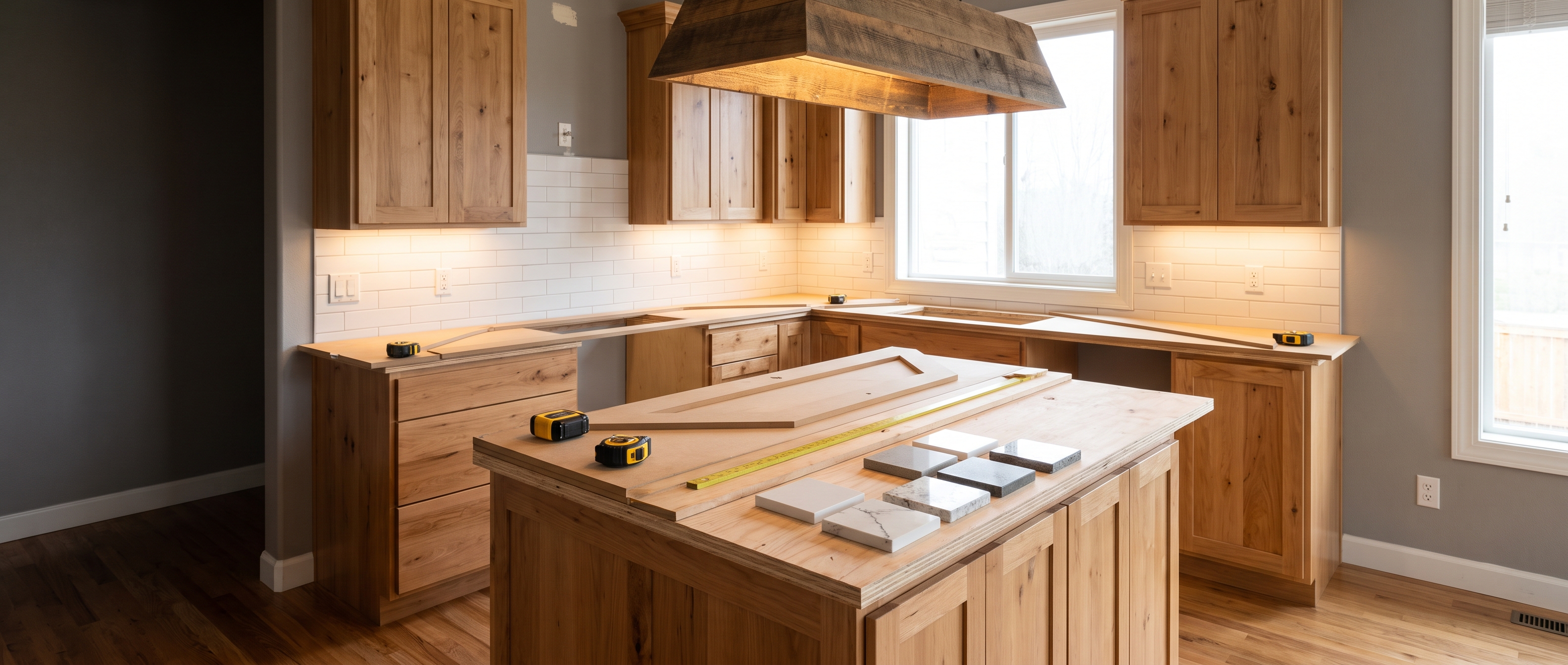
A standalone stone countertop job takes 2 to 3 weeks because a shop has to template, cut, and polish the slab before installation day. Butcher block skips that queue. A carpenter can cut it to length, ease the edges, scribe it to a wavy wall, and make the sink cutout right in your kitchen.
That matters in older homes. A lot of the 1960s and 1970s houses I open up around Tacoma, Lakewood, and South Hill have walls that aren’t straight and corners that aren’t square. Wood lets me fit the top to the house instead of fighting it.
It’s Easier on Dishes and Ears
Wood has a little give. Drop a glass on granite and it usually shatters. Drop it on maple and you have a decent shot at keeping it. Wood also stays quieter when you set down pots and plates.
The Cons: Where Butcher Block Lets Homeowners Down
Standing Water Ruins Wood
Standing water near the sink causes more early butcher block failures than anything else. Wood that sits wet swells, warps, and cracks. The area above the dishwasher takes a beating too, because hot steam hits the underside of the top every time you open the door after a cycle.
Here in the Pacific Northwest, water already gives me more trouble than anything else on remodels. I find water damage under kitchen sinks constantly when I open up older homes in Pierce County. Put a wood top over a sink base with a slow leak and you have two problems instead of one.
Upkeep Never Fully Goes Away
Plan on oiling a new oil-finished top about once a month at first. After that, oil it whenever water stops beading on the surface. Each coat needs to soak in, often overnight, before you wipe off the extra and use the counter.
Quartz needs none of that. Granite needs sealing once a year. Butcher block needs attention a few times a year for as long as you own it.
Heat Leaves a Permanent Mark
A pan straight off the burner can scorch wood for good. Light marks sometimes sand out. Deep ones don’t. If you’re the cook who slides a skillet off the stove onto the nearest counter without thinking, wood will punish that habit every single time and you’ll see the ring for good.
Soft Species Dent and Scratch
Maple, oak, and bamboo hold up well. Walnut and cherry rate only moderate for durability. They look beautiful, but a dropped cast iron pan or a toy truck will leave a mark you’ll see in the right light.
Wood Moves With the Seasons
Wood swells and shrinks across its width as humidity rises and falls. Our winters run damp outside, while a furnace running all day dries out the air indoors, and a top that can’t move with those swings will eventually crack. That comes down to how someone installed it.
I’ve built and remodeled everywhere from the tropical humidity of Guam to the cold of Alaska. Wood moves in every one of those climates. The installer’s job is to let it.
Can Butcher Block Survive Next to a Sink in a PNW Home?
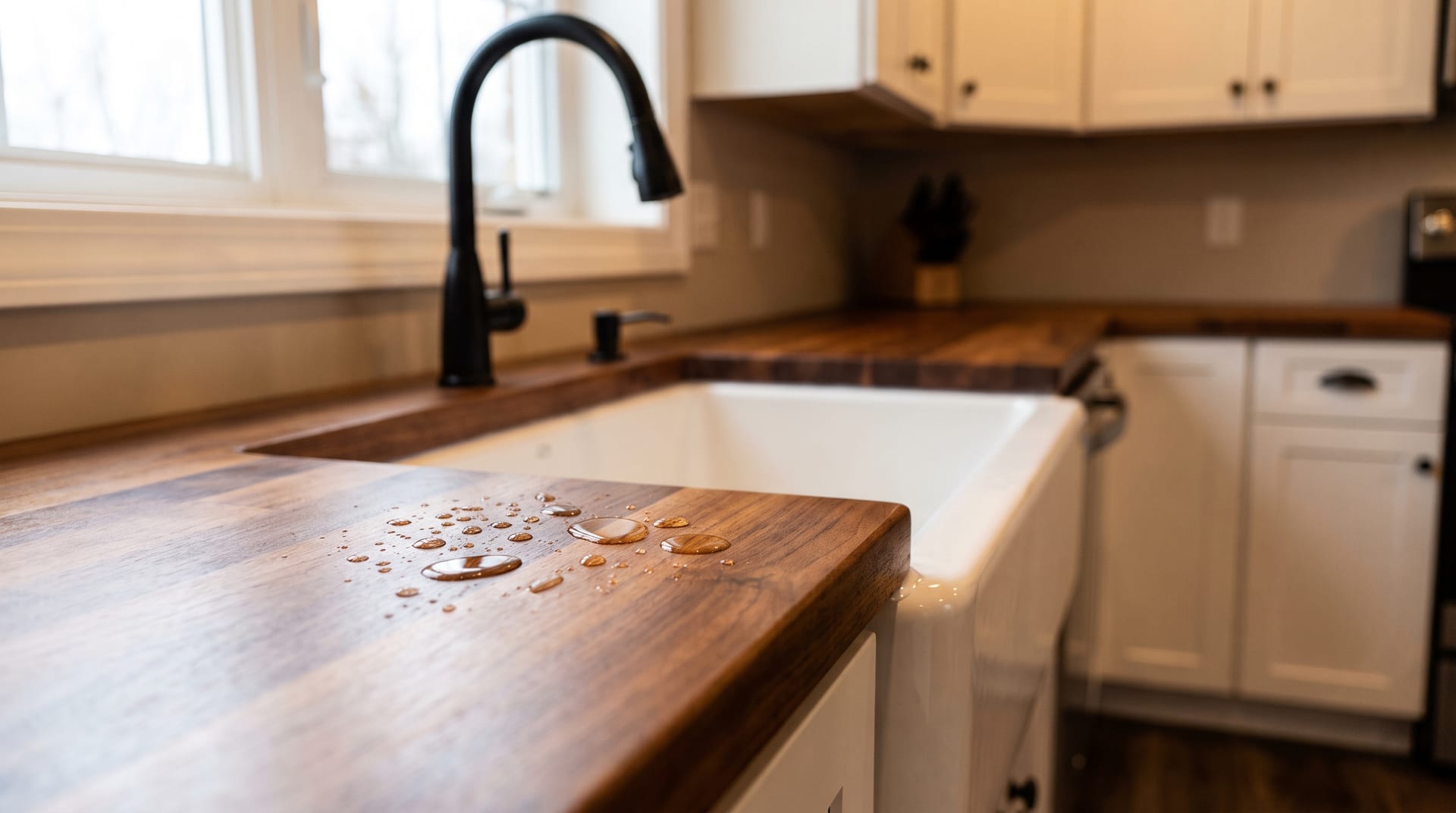
Yes, if you pick the right finish and detail the sink like you mean it. The finish decides most of the outcome.
| Finish | How it works | Next to a sink | Upkeep |
|---|---|---|---|
| Food-safe mineral oil | Soaks into the wood and never hardens | Weak. No real water barrier. | Reapply often |
| Mineral oil and beeswax blend | Oil soaks in, wax adds some water resistance | Better, still not great | Reapply often |
| Tung-oil resin finish (Waterlox is a common one) | Builds a hard film on the surface | Best of the three | Fix chips right away. Gloss shows fingerprints. |
Even the hard finish isn’t a permanent fix, and the manufacturer says so. Any chip or worn spot near the sink gives water a path into the wood, so you repair it the same week you see it, not next spring when the gray stain has already spread.
What I’d Do If This Were My Mom’s Kitchen
I run every job by one question: if this were my mom’s house, how would I want it done? If she wanted her sink set in wood, here’s my list:
- A hardening finish on the entire run around the sink, not just mineral oil.
- Finish on every cut edge of the sink opening and on the underside before the sink goes in.
- A bead of quality silicone where the sink meets the wood, and a check of that joint every few months.
- A dish rack on a drip tray, never sitting on bare wood.
- A quick wipe-down after every round of dishes.
Warning: Mineral oil alone at a sink sets a wood top up to fail. It never hardens, so it never forms a real water barrier. Save plain oil for islands and runs away from water.
The Smarter Move for Many Kitchens
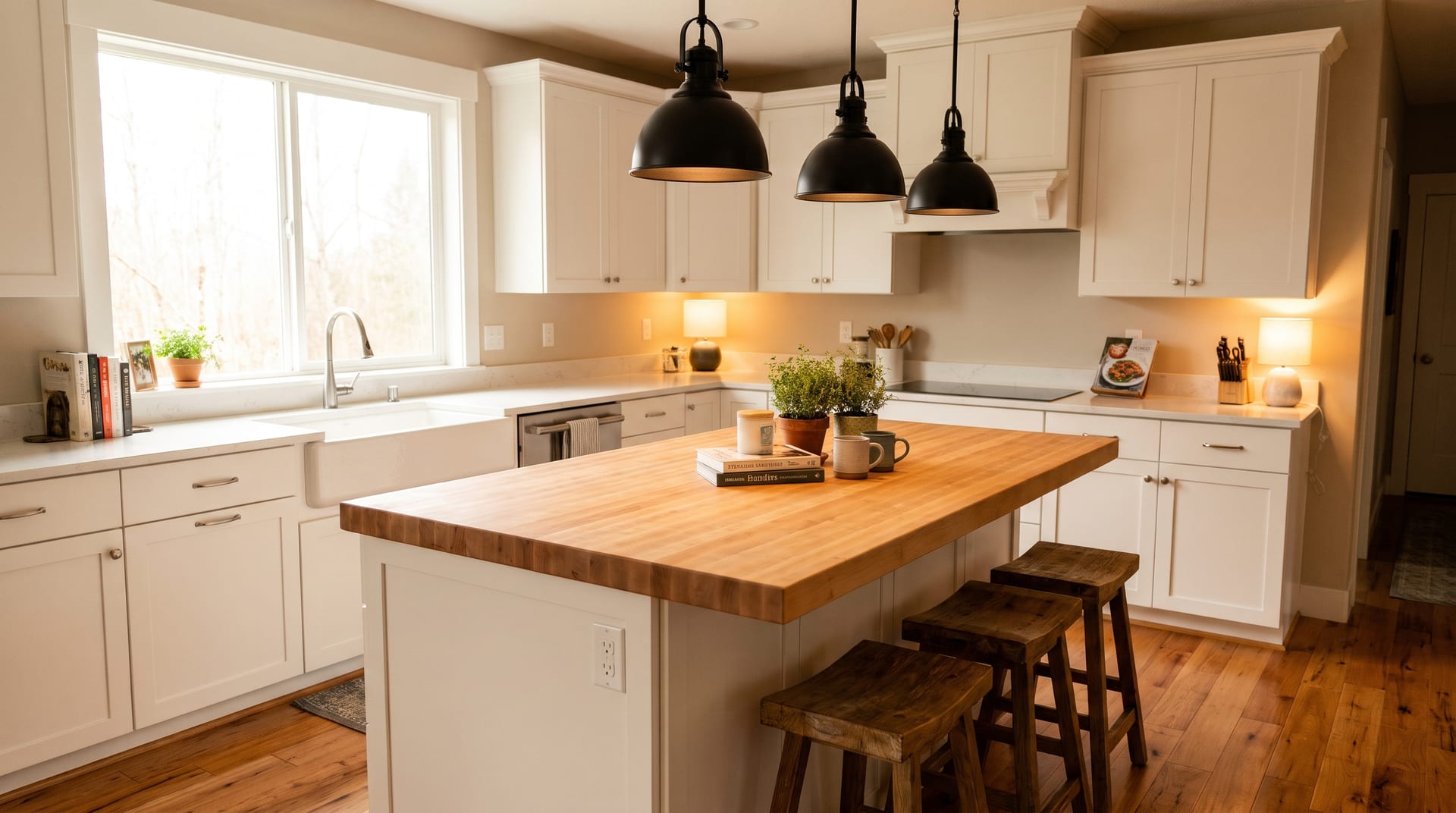
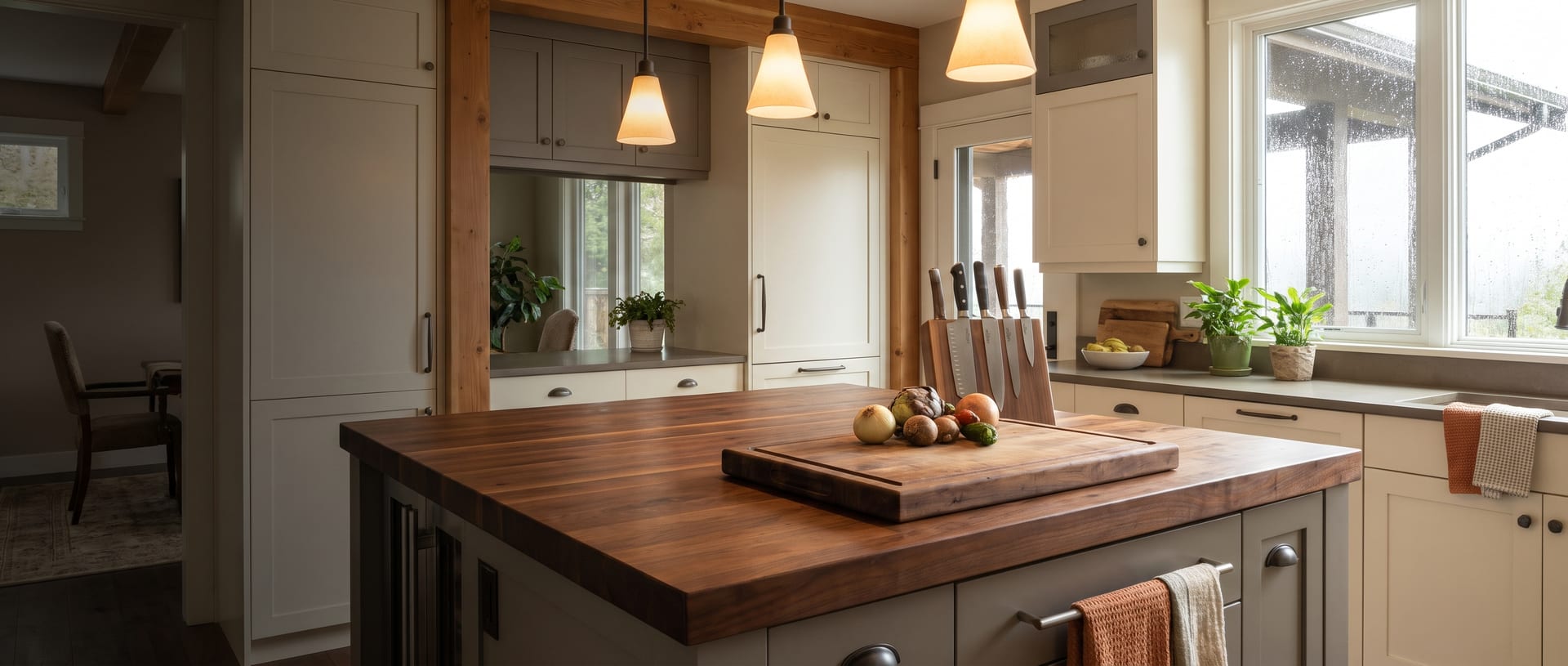
Keep the sink out of the wood. Put butcher block on the island, run quartz or granite around the sink, and you get the warmth of wood with a fraction of the risk. My kitchen island cost guide breaks down what islands run here in Pierce County.
A Farmhouse Kitchen I Remodeled With Butcher Block

This Pierce County kitchen shows what wood tops do in the right setting. My crew and I built a farmhouse-style kitchen with white shaker cabinets, butcher block countertops, a farmhouse sink, and a subway tile backsplash. Black industrial pendant lights, an electric cooktop in the island, bamboo window shades, and hardwood flooring throughout round it out.
The job covered kitchen remodeling, countertop installation, and flooring.
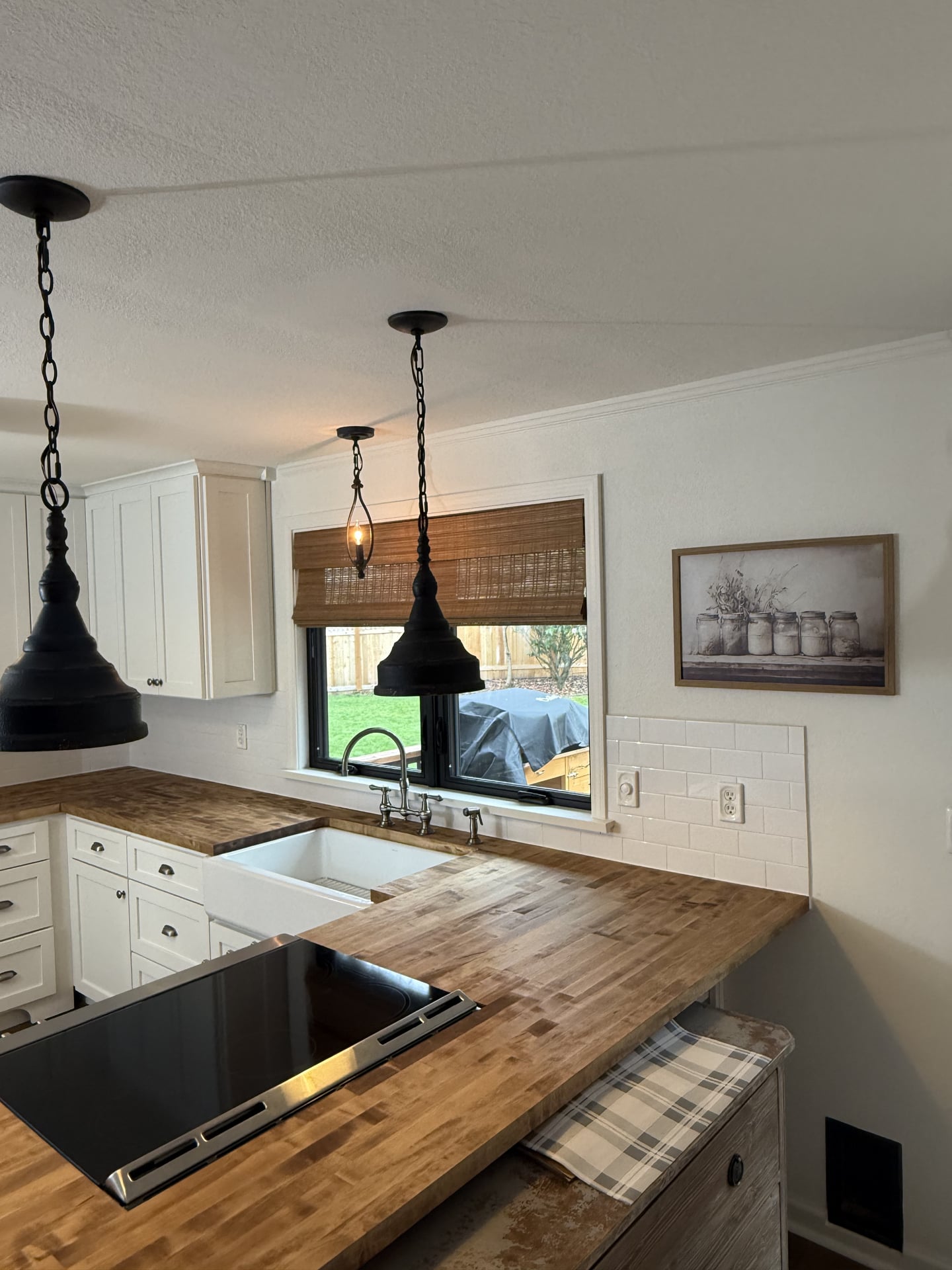
Butcher block fits a farmhouse kitchen because the whole style leans on natural materials and texture. White shaker doors give the wood something clean to play against, and the black pendants tie the dark accents together. Swap the wood for gray quartz and you’d have a completely different kitchen.
You can see more of the farmhouse kitchen with butcher block countertops on the project page. If you want this whole look, my farmhouse kitchen remodel cost guide walks through the numbers. A mid-range full kitchen remodel in Puyallup runs $35,000 to $88,000 and takes 6 to 10 weeks.
Which Wood Species and Grain Hold Up Best?
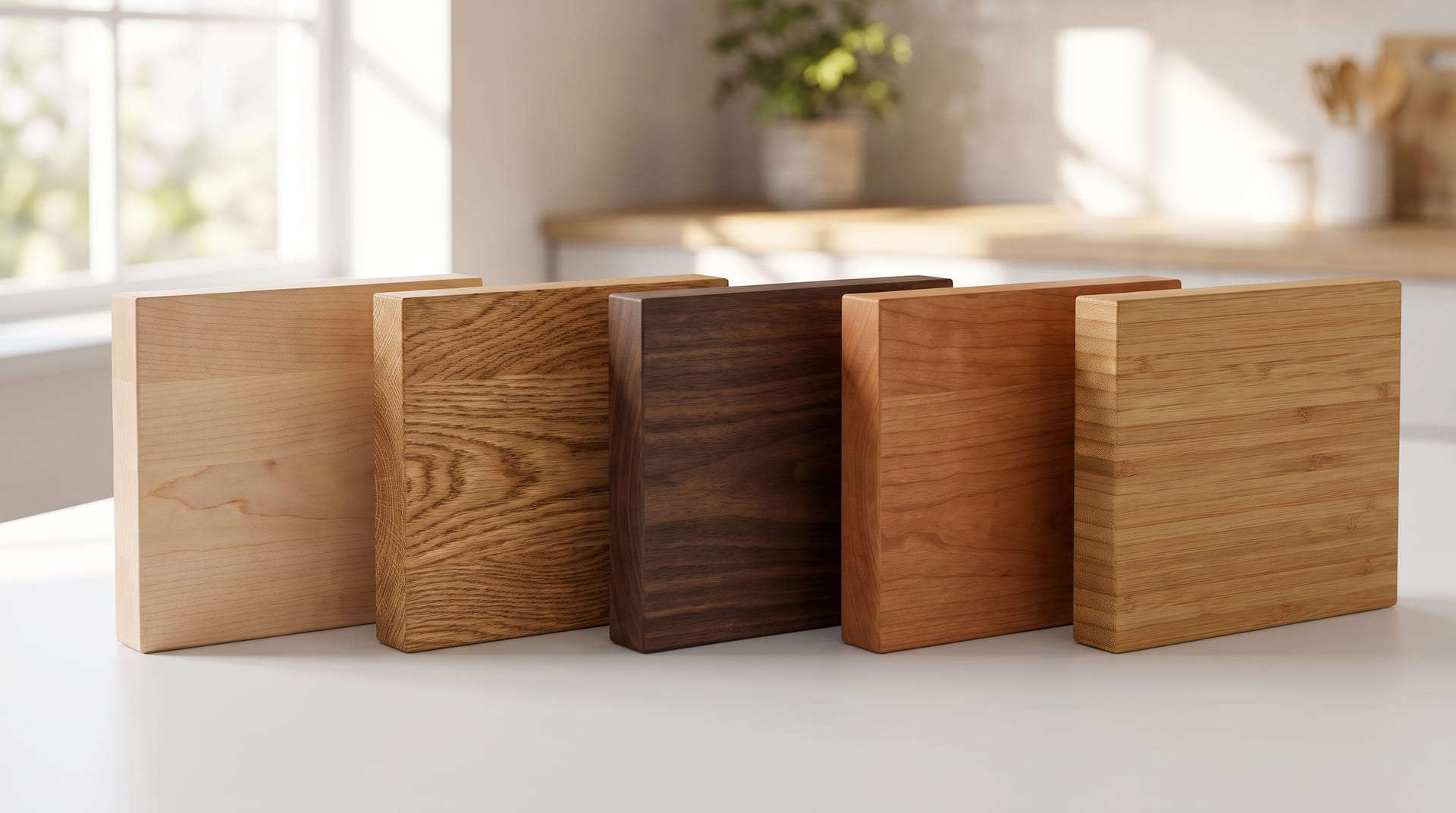
Species decides how hard your top is, what it looks like, and how it ages.
| Species | Durability | Look | Where I’d put it |
|---|---|---|---|
| Maple | Very durable | Light color, fine grain | Busy family kitchens, full runs |
| Oak | Durable | Strong, visible grain | Farmhouse and traditional kitchens |
| Walnut | Moderate | Deep chocolate brown | Islands and low-traffic runs |
| Cherry | Moderate | Reddish, darkens with age | Islands and accent pieces |
| Bamboo | Highly durable | Uniform, linear look | Modern kitchens |
If you choose oak anywhere near water, ask for white oak instead of red oak. Red oak has open pores that pull water deep into the wood. White oak grows natural plugs inside its pores, which is why boat builders and barrel makers have trusted it for centuries.
Edge Grain, End Grain, or Face Grain
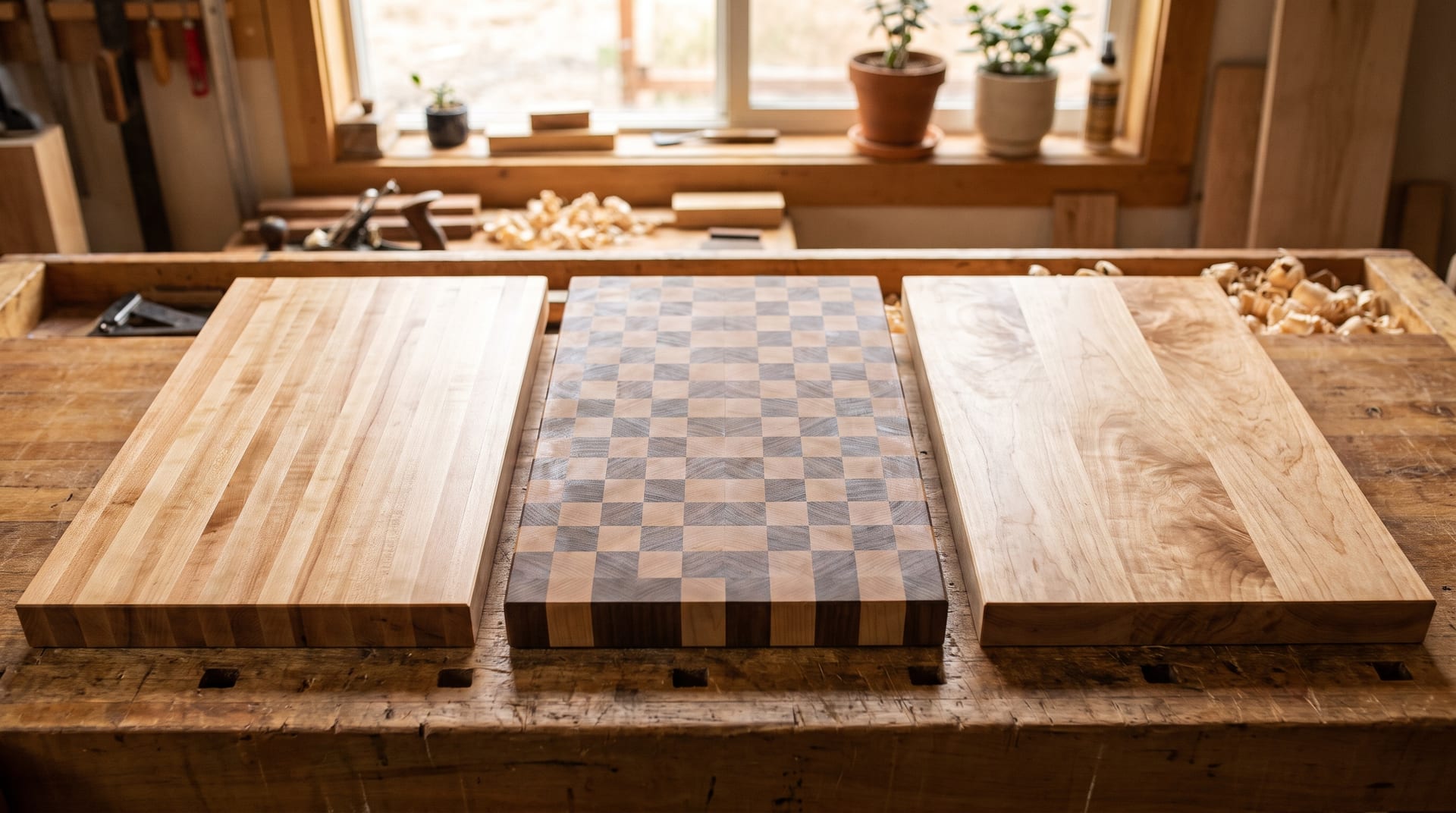
- Edge grain: Long strips standing on edge. This gives you the best balance of looks and strength, and it’s what most kitchen tops use.
- End grain: The checkerboard pattern you see on serious cutting boards. It’s the toughest style and the most expensive.
- Face grain: Wide boards lying flat. It shows off the most figure in the wood but wears the fastest.
My pick for most kitchens: Edge-grain maple at 1.75 inches thick. It’s hard, it’s stable, and it costs less than walnut or end grain.
Install Details That Decide Whether Wood Tops Crack
A lot of butcher block failures trace back to install day, not to the homeowner. Here’s what I look for on any wood countertop install. Use it to check whoever installs yours.
- Finish it fast. One manufacturer’s instructions call for sealing or finishing the top within 48 hours to prevent cracking and splitting. Bare wood sitting in a garage for two weeks is asking for trouble.
- Finish all six sides. That means the underside and every cutout edge. My dad drilled one rule into me: do it right even when nobody’s looking. The underside of a countertop is exactly that kind of work.
- Fasten through slotted or oversized holes. The screws hold the top down while the wood slides across its width with the seasons.
- Skip the construction adhesive. Glue locks the slab down, and a slab that can’t move cracks or splits the cabinet top.
- Leave a gap at inside corners. On L- and U-shaped kitchens, leave a 1/8 inch gap and fill it with silicone instead of forcing a tight butt joint.
- Level the cabinets first. Shim out-of-level boxes before the top goes on, and don’t let the shims pin the wood in place.
- Measure twice, cut once. A wrong sink cutout doesn’t patch. You buy a new slab.
Construction adhesive on butcher block feels like extra insurance. It works the opposite way. Wood that can’t move will crack, and you’ll pay to replace the top.
Butcher Block vs. Quartz: When I Steer Homeowners Toward Stone
Quartz is the most popular countertop I install, and it never needs sealing. I’ll point you toward quartz over wood if any of these sound like you:
- You cook hot and fast and won’t use trivets.
- You want a counter you never have to think about.
- Kids splash at the sink every night and nobody wipes it dry.
- You plan to sell soon and don’t want buyers worrying about upkeep.
For comparison, my dark cabinet kitchen with island pairs dark stained shaker cabinets with quartz countertops and a center island with a gas cooktop. It’s a different look and a different maintenance routine.
If you’re torn between stone types, my breakdown of quartz vs. granite countertops covers cost, durability, and care for both.
The Mixed Approach: Wood Island, Stone Perimeter
Plenty of kitchens get the best of both. Here’s the math on a kitchen with 30 square feet of perimeter counter and a 20 square foot island:
| Layout | Cost range |
|---|---|
| All quartz (50 sq ft) | $8,250-$11,500 |
| Quartz perimeter + butcher block island | $5,850-$9,300 |
| All butcher block (50 sq ft) | $2,250-$6,000 |
The mixed layout saves you $2,200 to $2,400 over all quartz. That’s real money, but the bigger win is keeping wood away from the sink, where it tends to fail, and putting it on the island, where everyone sees it and nobody leaves a wet dish rack on it.
Before You Order Butcher Block: A Checklist
Once you’ve weighed the butcher block countertops pros and cons and decided wood belongs in your kitchen, run through this before you buy a slab or sign a bid:
- Decide whether the sink sits in wood or in stone
- Pick a finish that matches how wet each area gets
- Choose a species for your traffic (maple or oak for busy kitchens)
- Confirm the thickness (1.75 inches is a common standard)
- Ask the installer how they fasten the top and handle inside corners
- Ask whether they finish the underside and cutout edges
- Check the sink base for soft spots or water stains before the new top goes on
- Buy trivets and a large cutting board before install day
- Make sure every bid lists the same species, thickness, finish, and cutouts
- Set aside 15-20% of your budget for surprises if you’re opening up an older kitchen
Butcher Block Questions Homeowners Ask Me
How often do I need to oil butcher block countertops? Oil an oil-finished top about once a month at first. After that, oil it whenever water stops beading on the surface, which works out to a few times a year in most kitchens. A hardening finish like Waterlox doesn’t need monthly oiling, but you need to repair any chip or worn spot right away and recoat when it wears thin.
Can I cut directly on butcher block? You can, but I wouldn’t. Knife marks sand out, but every cut opens the finish and gives water a way in. Use a cutting board. On a top with a hard film finish, never cut on it at all.
Can I set hot pans on butcher block? No. A hot pan can leave a permanent scorch mark. Keep trivets next to the stove and use them every time.
Keep two trivets within arm’s reach of the stove. If you have to walk to a drawer, you’ll skip it.
How do I clean butcher block countertops? Use mild dish soap and a barely damp cloth, then wipe it dry. Skip bleach. Never let water or spills sit.
Is butcher block sanitary for food prep? A fully sealed wood surface resists stains and germs better than bare wood. Stick to food-safe finishes like mineral oil or products with NSF approval for food contact. If you leave the wood unsealed, you need to stay on top of oiling.
Do I need a permit to replace countertops in Puyallup? The residential building code most Washington cities adopt treats countertops as finish work that doesn’t need a building permit. Moving the sink, adding outlets, or changing plumbing is a different story and can need its own permit. Call the City of Puyallup before you start, or Pierce County if you live in an unincorporated area like Graham or South Hill.
Also Serving Pierce County
I install countertops for homeowners across Pierce County, including Tacoma, South Hill, Sumner, Bonney Lake, Edgewood, Lakewood, and Graham. You get the same honest pricing and the same standard of work in every one of them.
Get a Straight Answer on Wood or Stone for Your Kitchen
If you’ve read every one of these butcher block countertops pros and cons and still can’t decide, that’s normal. Wood can make a kitchen feel warm and lived-in for years. It can also swell and crack at the sink if someone gets the finish or the install wrong.
I’ll come out, look at your sink, your cabinets, and how you actually cook, and tell you straight whether wood fits your kitchen or whether stone will serve you better. Financing is available on kitchen remodels.
Here’s what another kitchen client had to say:
“We have used Pacific Remodeling LLC for 2 projects on our home now and have never been happier with the finished work. This last project was on our kitchen and it turned out amazing! It is hard to find the right words to describe how great this company is. Brad is professional, friendly, listens to what you want and works hard to make it happen. We are so lucky to have found these guys!”
Traci H., Google review
Get Your Free Estimate: call me at (253) 392-9266 or schedule your free countertop estimate online.
Brad Zemke, Owner Pacific Remodeling LLC Puyallup, WA