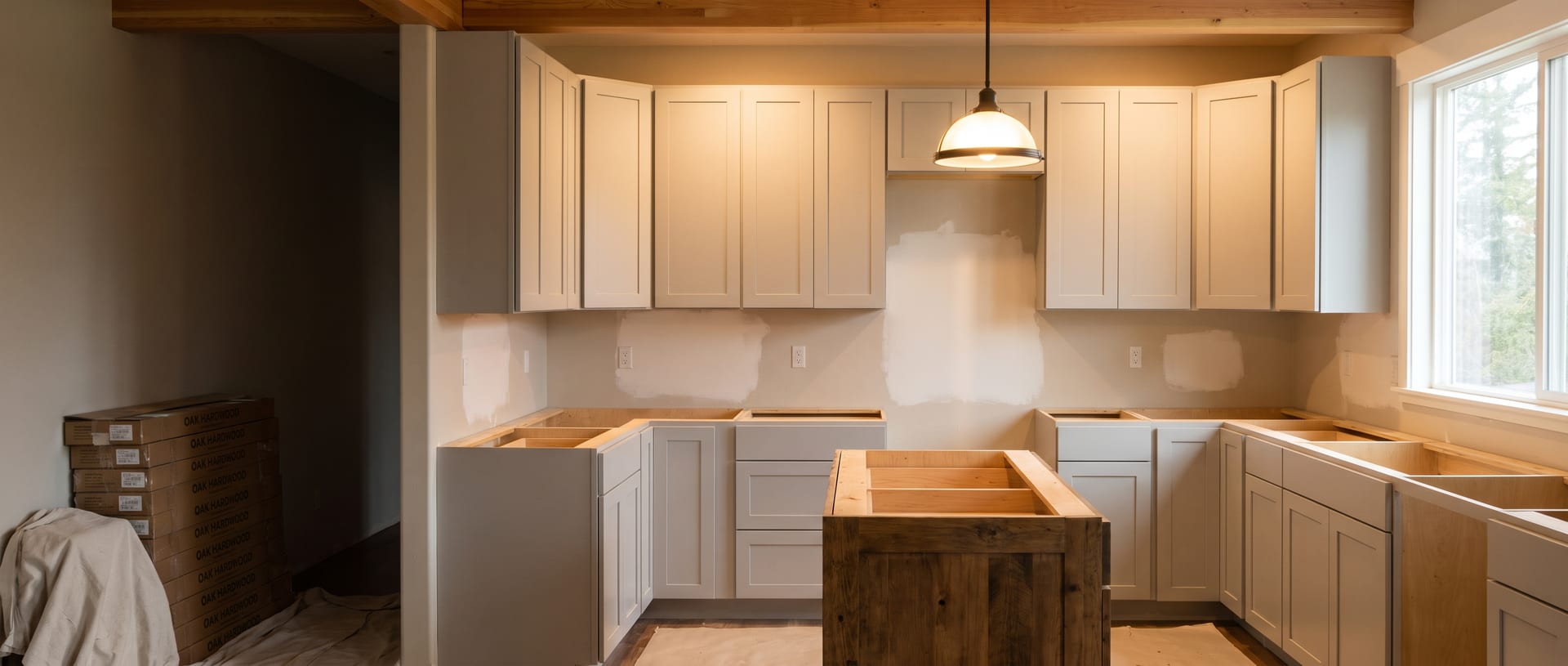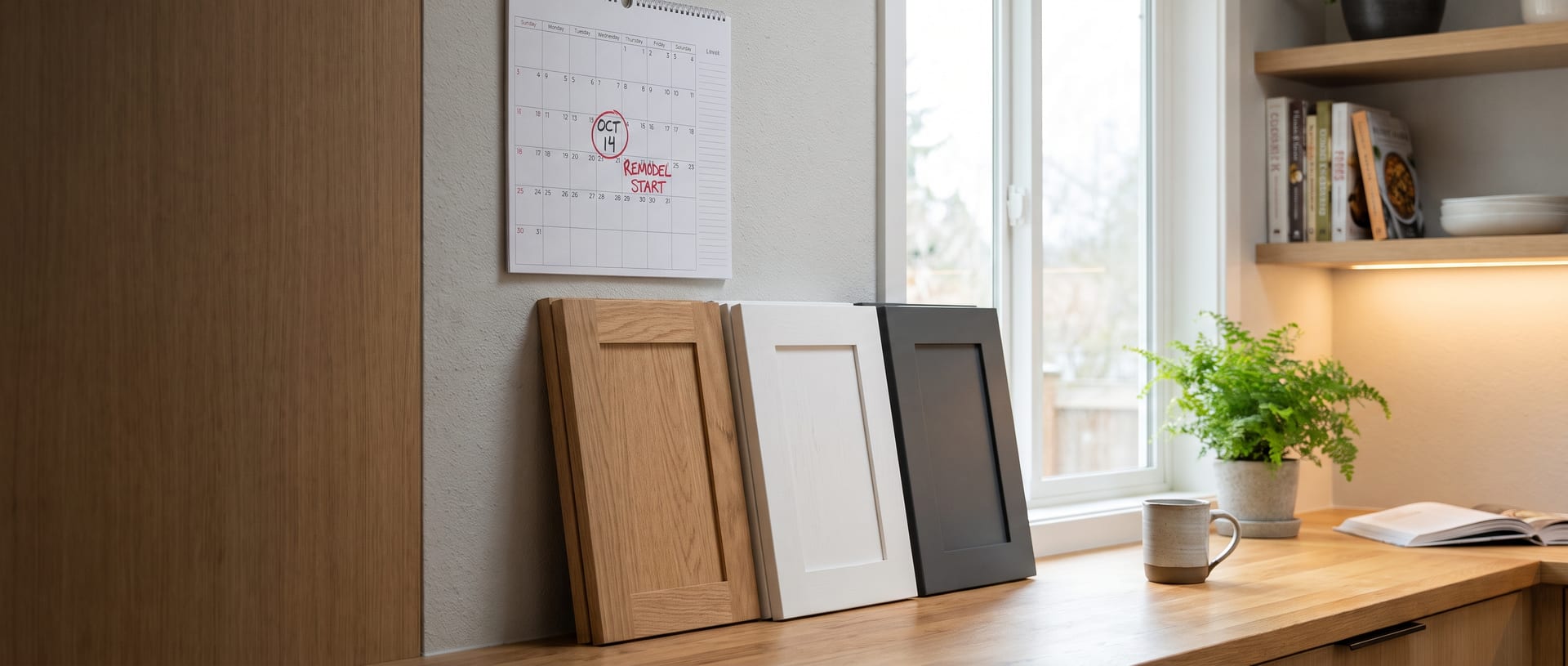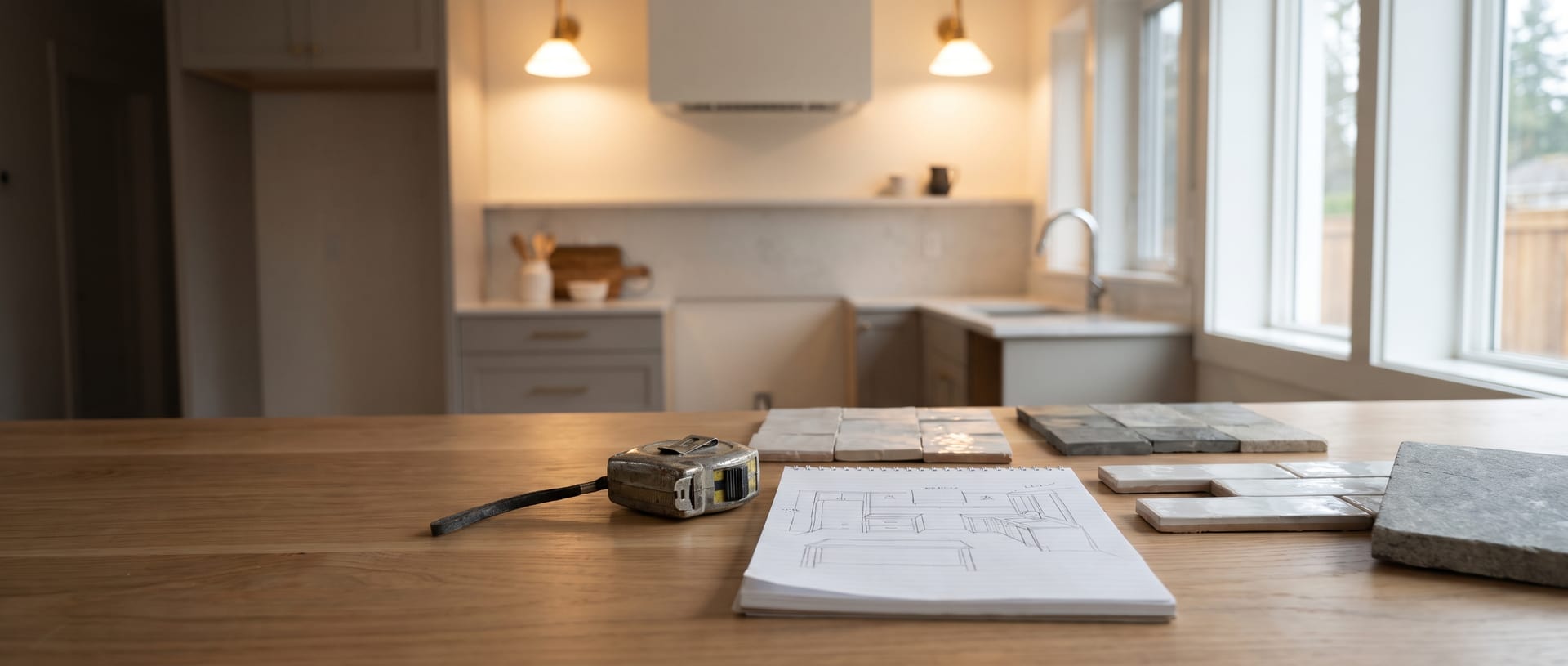
Here’s the short version of a free remodeling estimate: what to expect, what it costs, and what you get afterward. For an average kitchen or bathroom, I spend about 30 minutes in your home. It costs you nothing. Then you get a detailed line-item estimate that lists and explains exactly what the job covers.
Bigger jobs take longer to walk. Think load-bearing walls, full layout changes, or a garage conversion. The steps stay the same.
I’m a third-generation carpenter and Air Force veteran with 20+ years in the trades. I started Pacific Remodeling in Puyallup in 2018, and I’ve finished more than 500 projects since then, from full remodels to small fixes.
“We received 3 bids and his was clear, easy to understand and fair.” (JB S., Google review)
Clear. Easy to understand. Fair. That’s the bar I hold every estimate to, and this post shows you how I get there.
Free Remodeling Estimate: What to Expect, Step by Step
Here’s how a visit runs, from the first call to the written estimate in your hands.
- You reach out. You call or send a message through my contact page, and we pick a time that works for you.
- I walk the room with you. I look at the space as it sits today, measure it, and ask how you use it every day.
- We talk about what you want. Your goals, your must-haves, your budget, and your timeline.
- I look for trouble behind the finishes. Water stains, soft floors, and old wiring or plumbing can all change the scope.
- I walk you through the process. Design, permits, material lead times, and what living through a remodel actually feels like.
- You get a line-item estimate. Every line names a piece of the job and explains what it covers.
Steps 1 through 5 fit inside about 30 minutes for an average kitchen or bathroom. Step 6 comes after the visit.
Have everyone who makes decisions about the house at the walkthrough. If one person hears the plan firsthand and the other hears it secondhand, details fall through the cracks.
Is the In-Home Estimate Really Free?
Yes. You don’t pay for the visit, and you don’t pay for the written estimate. Hiring me afterward stays your call.
Not every contractor works this way. Some charge for estimates, especially on small jobs. Some credit that fee toward the contract if you hire them. Just ask before anyone shows up, so the bill doesn’t catch you off guard.
I keep mine free for a simple reason. If my mom were shopping for a contractor, I’d want her to get a straight answer without a fee standing in the way. That’s the Golden Rule, and I run my business on it.
What “Free” Should Still Get You
A free estimate still needs to be a real estimate, because a lowball number that leaves out half the job will cost you more than an honest number ever would. From any contractor, free or paid, expect:
- A walkthrough of your actual space, not a guess over the phone
- Honest questions about your budget and timeline
- A written estimate with line items, not one lump sum
- Specific materials, not just “tile” or “cabinets”
- Straight answers about permits and who pulls them
My standard comes from Colossians 3:23: “Whatever you do, work at it with all your heart.” That applies to a 30-minute walkthrough as much as it applies to a tile job.
How Long Does the Estimate Visit Take?
Usually around 30 minutes for an average bathroom or kitchen remodel. A more extensive job may take longer, because I have more to measure, more to look at, and more to talk through with you.
Here’s what the visit looks like by project type, along with the price ranges from my own pricing here in Pierce County.
| Project | Estimate Visit | Typical Price Range |
|---|---|---|
| Half bath or powder room | Around 30 minutes | $6,500-$16,000 |
| Guest or hall bath | Around 30 minutes | $16,000-$35,000 |
| Tub-to-shower conversion | Around 30 minutes | $10,000-$24,000 |
| Mid-range master bath | Around 30 minutes | $33,000-$72,000 |
| Kitchen budget refresh | Around 30 minutes | $16,000-$40,000 |
| Mid-range full kitchen remodel | Around 30 minutes | $33,000-$88,000 |
| High-end master bath with layout change | May run longer | $59,000-$105,000+ |
| Kitchen with major layout or structural changes | May run longer | $78,000-$160,000+ |
| Garage conversion ADU | May run longer | $78,000-$190,000 |
These ranges give you a starting point, not a quote. Here’s how long the actual work usually takes once it starts:
- Full kitchen remodel: 6-10 weeks
- Smaller kitchen projects: 2-3 weeks
- Full bathroom remodel: 3-5 weeks
- Complex bathroom projects: 6-8 weeks
- Tub-to-shower conversion: 7-10 business days for the build, about 2 weeks total with glass fabrication
- ADU conversions: 8-14 weeks, plus 4-8 weeks for permits
Your real number depends on your room, your materials, and what I find when I look closely. For a deeper look at pricing, read my guide to what a kitchen remodel costs in Puyallup or my Puyallup bathroom remodel cost breakdown.
What I Look At While I’m in Your Home
I spent 5 years as a B-52 crew chief in the Air Force. On a bomber, you follow the checklist and you don’t skip steps. I walk your kitchen or bathroom with that same habit.
The Room Itself
I measure walls, cabinet runs, counter lengths, and ceiling height. I note where the sink, toilet, range, and outlets sit today. “Measure twice, cut once” starts at the estimate, not on demo day.
Location drives price. Leaving plumbing where it sits costs less than moving it. Kitchen work needs permits for wall moves, plumbing relocation, and electrical work.
Removing a load-bearing wall in a kitchen adds $4,000 to $13,000 to the project. If you want a wall gone, I’ll look at whether it carries load before we talk numbers.
Signs of Trouble Behind the Finishes
Moisture is the number one enemy of Pacific Northwest homes. Our rain finds its way behind walls, under sinks, and around windows, especially in older houses. I’ve opened walls expecting a simple remodel and found rot that changed the entire scope.
That’s why I look for warning signs on every walkthrough:
- Stains, swelling, or a musty smell in the sink base cabinet
- Soft spots in the floor near the toilet or tub
- Peeling paint or dark spots around windows
- Cracked grout or loose tile in the shower
- Outdated wiring or plumbing that won’t pass current code once we touch it
I can’t see through drywall. Nobody can. These signs tell me where to plan for surprises, so your estimate reflects your actual house instead of a perfect one.
The Age of Your House
A lot of homes around Puyallup, South Hill, and Graham predate modern code. When I touch one system in an older house, I often have to bring others up to current code too. Electrical and plumbing upgrades are the usual surprises.
If your house went up before 1978, any contractor who disturbs more than 6 square feet of interior paint or 20 square feet of exterior paint has to follow Washington’s lead-safe rules. The Washington Department of Commerce certifies the firms that do this work. Each firm needs a Certified Renovator who completed an 8-hour course.
How You Live and What You Can Spend
Bidding a job takes more than adding up materials and labor. I want to know how you cook, who uses the bathroom, and what bugs you about the room right now. Listening tells me as much as my tape measure does.
“Brad listened, observed, and reinstalled everything new to make things right.” (Trina S., Google review)
I also ask about budget, so I can show you options that fit it, because a beautiful plan you can’t afford doesn’t help either one of us. Know your real number before I arrive. Not what you hope it costs. What you can actually spend, plus 15-20% for surprises.
What to Have Ready Before I Show Up
You get the most out of a free remodeling estimate when you show up prepared. For years, I’ve asked homeowners to pull up Pinterest photos of rooms they like before the visit. Then I show them photos of my own past work so they can see what fits their space.
Know what you want before work starts. Every “actually, can we change that?” in the middle of a project adds time and money. A little prep before the estimate saves you a lot of that later.
- Your real budget, plus 15-20% for surprises
- Photos of rooms you like from Pinterest, magazines, or friends’ homes
- A short list of must-haves and a separate list of nice-to-haves
- Every decision-maker home for the visit
- Your timeline, including dates that matter, like holidays or a planned sale
- Known problems: leaks, soft spots, a fan that never worked
- Appliance or fixture models you already picked out
- Your questions on paper so you don’t forget them
What’s in the Estimate I Send You
My estimates are detailed line items that list and explain exactly what the job covers. You won’t get one lump sum with the words “kitchen remodel” next to it.
Vague estimates protect the contractor. Detailed ones protect you. Line items let you see exactly what you’re paying for, compare bids fairly, and decide where to spend and where to save.
How a Kitchen Estimate Breaks Down
Here’s what solid line items should tell you on any kitchen bid, with typical ranges from my own pricing.
| Line Item | What It Should Tell You | Typical Range |
|---|---|---|
| Custom cabinets | Construction type and door style | Thermofoil $8,000-$22,000. Plywood box with wood doors $13,000-$35,000. Solid wood $20,000-$56,000 |
| Countertops | Material and square footage | Quartz $70-$190/sq ft installed. A typical 40 sq ft quartz kitchen runs $2,800-$7,600 |
| Flooring | Material, square footage, and removal of the old floor | LVP $5-$13/sq ft. Tile $10-$24/sq ft. Hardwood $13-$26/sq ft |
| Wall removal | Whether the wall carries load | Load-bearing: $4,000-$13,000 extra |
| Plumbing | Fixtures, and whether anything moves | Depends on scope |
| Electrical and lighting | New circuits, fixtures, and code updates | Depends on scope |
| Permits | Which permits the job needs and who pulls them | Depends on scope |
If two bids list different square footage for the same countertop, somebody measured wrong. Find out who before you sign.
Why the Number Might Surprise You
Most homeowners I meet haven’t priced a remodel before. That’s normal. TV shows compress a three-month job into a 30-minute episode and skip the permits, the inspections, the surprises behind the walls, and the weeks of waiting on cabinets.
Then there’s the hourly rate. I hear some version of this question a lot: “Why would I pay a contractor $100 an hour when I make $30 an hour?”
The hourly rate isn’t profit. It keeps a legitimate business alive. Here’s what it pays for:
- Liability insurance
- L&I registration and bond
- The truck, the tools, and the fuel
- Business licenses
- Warranty work if something fails
- Employees and subcontractors
- 20+ years of learning how to do the work right
Good, Fast, or Cheap
I say this at a lot of estimate visits. Good, fast, or cheap. Pick two.
Want it good and fast? It won’t be cheap. Want it good and cheap? It won’t be fast. Want it fast and cheap? It won’t be good. Setting that expectation at the estimate saves everyone grief later.
How to Compare Three Bids Line by Line
Washington’s Attorney General suggests getting about three written bids. Good advice. The trick is making sure all three cover the same job.
The biggest mistake I see homeowners make is choosing on price alone. Some contractors leave scope off the bid on purpose so their number looks like the best deal, then hit you with change orders once your old kitchen sits in a dumpster and switching contractors mid-job no longer makes sense. The cheap bid ends up costing more than the honest one.
Hidden work will get you, too. I’ve underbid jobs where rot, old wiring, or plumbing that wasn’t up to code showed up once the walls came open. I learned from that, and an honest estimate talks about those risks up front.
Line up your bids side by side and check these six things:
- Scope. Does every bid cover the same rooms, the same demo, and the same finish work?
- Materials. Does the bid name the cabinet type, countertop material, and flooring, or does it just say “tile”?
- Missing lines. If one bid has a line for permits or disposal and another doesn’t, ask why.
- Change orders. How does each contractor handle changes, and do they put them in writing?
- Hidden conditions. What happens to the price if they find rot behind the tub?
- Warranty. What does each contractor cover if something fails?
For more traps like these, read my post on how to avoid common remodeling mistakes.
You get what you pay for. There’s usually a reason the cheapest bid is the cheapest.
Check the Contractor Before You Open the Door
Washington requires every construction contractor to register with the Department of Labor & Industries. Working unregistered is a gross misdemeanor. Check before the estimate visit, not after you sign.
L&I’s Verify tool shows a contractor’s registration, liability insurance, business license, and bond status. You can also call L&I at 1-800-647-0982 or visit ProtectMyHome.net.
Check their work, not their pitch. Smooth talkers aren’t always good builders. You can read about my background and how I work, then see what homeowners say on my reviews page.
Questions to Ask Any Contractor at the Estimate
- What’s your L&I registration number so I can look it up?
- Do you carry liability insurance and a bond?
- Who pulls the permits, and does the estimate list them?
- Will I get line items, or one total?
- How do you handle change orders, and do they come in writing?
- What happens to the price if you find rot or bad wiring behind the walls?
- What does your warranty cover if something fails?
- My house dates from before 1978. Does your firm hold lead-safe certification from Washington Commerce?
- Will the contract spell out price, payment terms, sales tax, permit fees, scope, materials, and warranty?
Two Finished Projects From My Portfolio
Line items on paper turn into rooms you live in. Here are two projects from my portfolio and the features that went into each one.
Green Cabinet Kitchen Remodel

On this kitchen, we put in green shaker cabinets, a herringbone marble tile backsplash, a stainless steel range hood, and quartz countertops. It’s a fresh take on a classic kitchen. See more photos on the green cabinet kitchen remodel project page.
On any kitchen estimate, choices like these show up as separate lines: cabinets, countertops, backsplash tile, and the range hood. Quartz needs no sealing, which makes it the most popular countertop I install.
Modern Green Tile Shower

This walk-in shower has stacked green glass tile, a frameless glass door, a natural stone mosaic niche, and matte black fixtures. It’s one of my favorite tile jobs. You can see the before and after on the modern green tile shower project page.
A shower estimate should spell out tile, waterproofing, glass, the niche, and fixtures as separate pieces. In the Pacific Northwest, a shower bid that skips the waterproofing details is a red flag.
What I Walk Every Client Through Before Work Starts
Most surprises in a remodel have nothing to do with tile or cabinets. They come from the process. Here’s what I cover at the estimate so none of it catches you off guard:
- The design phase takes time. You won’t see hammers swinging on day one. Design, material selection, planning, and approvals come first.
- Permits and inspections add weeks. Inspectors come out more than once during a project, and nobody gets to skip that step.
- Materials have lead times. Custom cabinets, specialty tile, and certain fixtures can take 4-8 weeks to arrive. The order has to go in early or the project stalls.
- You’re living in it. You’ll go weeks without a working kitchen or bathroom. You can stay in your home, and we set up dust barriers. With a second bathroom, you don’t need to move out for a bathroom remodel.
What Permits Cost in Puyallup
Sample City of Puyallup building permit receipts show fees from $55.50 to $492.25, each with a $6.50 state building code fee on top. If the city sends plans back for changes, each resubmittal costs $180. Bathroom permits typically run $250 to $800.
Permit fees run small next to the cost of the project. Skipping them to save a few hundred dollars is a bad trade.
For the full rundown, see my guide on which Puyallup remodels need a permit.
Questions Homeowners Ask Before the Estimate
Is the in-home estimate really free?
Yes. The visit and the written estimate cost you nothing. Some contractors charge for estimates, so ask any contractor up front.
What happens at the estimate?
I walk the room with you, measure, and look for signs of water damage or outdated systems. We talk about your goals, budget, and timeline. I also walk you through the process, from design and permits to living through the work. After the visit, you get a detailed line-item estimate.
How long does the estimate visit take?
Usually around 30 minutes for an average bathroom or kitchen remodel. A more extensive job, like a layout change or structural work, may take longer.
What’s in the estimate you send?
My estimates are detailed line items that list and explain exactly what the job covers. You can hold it next to other bids and compare the same pieces side by side.
Can the price change after demo starts?
On any remodel, it can. Rot, old wiring, or plumbing that doesn’t meet code can change the scope once the walls come open. Before you sign with anyone, ask how they handle change orders and whether they put every change in writing.
Can I stay in my home during the remodel?
Yes. You can live in your home during a kitchen remodel, and we set up dust barriers. For a bathroom remodel, you don’t need to move out if you have a second bathroom.
Is financing available?
Yes, financing is available for kitchen remodels. Bring it up at the visit and we’ll talk it through.
Do I need to know exactly what I want before you come out?
No. A few photos and a rough budget give us plenty to work with. The clearer your vision before work starts, though, the less you’ll spend on mid-project changes.
Also Serving South Hill, Bonney Lake, Tacoma, and Nearby Towns
I schedule free estimates in Puyallup and across Pierce County. That includes South Hill, Graham, Bonney Lake, Sumner, Edgewood, Tacoma, and Lakewood. The visit works the same way in every town: about 30 minutes for an average kitchen or bathroom, then a detailed line-item estimate.
Book Your Free Estimate
“He is prompt with responses and appointments and was clean and tidy during the entire process.” (Holly B., Google review)
Now you know what to expect from a free remodeling estimate: about 30 minutes in your home, honest answers about cost and process, and a detailed line-item estimate you can compare against anyone’s. All that’s left is picking a time.
Call me at (253) 392-9266 or book your free estimate online. I’ll treat your home the way I’d want someone to treat my mom’s.
Brad Zemke, Owner Pacific Remodeling LLC Puyallup, WA