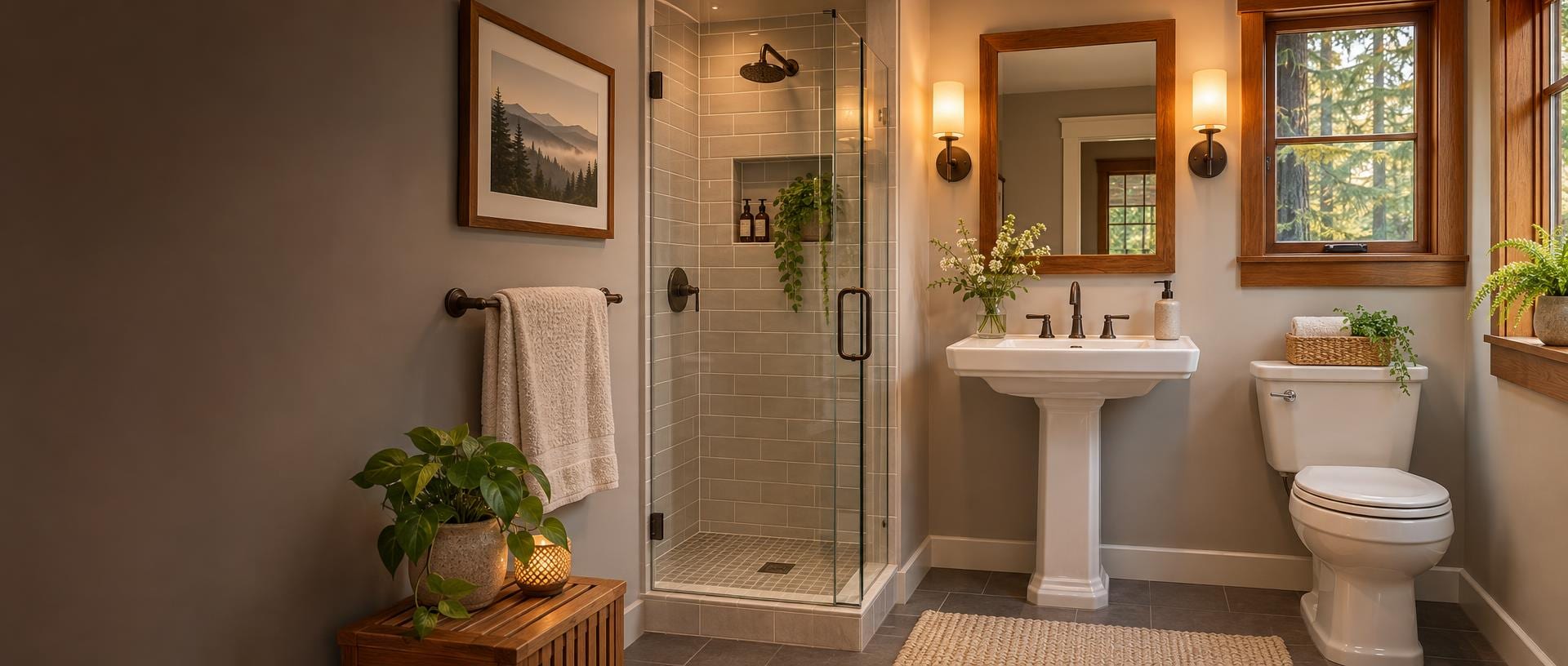
Here’s the straight answer on convert half bath to full bath cost in Puyallup: most jobs run $13,000 to $32,000. That matches what a full guest or hall bath costs in my own 2026 bids, because a full guest bath is exactly what you end up with. If the plumbing sits close and you have room for a shower without moving walls, you’ll land near $13,000. If you need to move a wall, borrow closet space, or run a new drain line across the house, plan for the top of that range or more.
I’m Brad Zemke. I’m a third-generation carpenter and Air Force veteran with 20+ years in the trades, and I’ve run Pacific Remodeling LLC in Puyallup since 2018.
Here’s what one client wrote after I took their master bath down to the studs and moved the plumbing:
“I am so glad we found Pacific Remodeling. Brad was great to work with from the start. We received 3 bids and his was clear, easy to understand and fair. We had Brad do a complete remodel of our master bath and put new floors, countertops and fixtures in our guest bath and laundry room. Brad did everything from the demo to the tile work himself. He had to take the master bathroom down to the studs, move plumbing, electrical fixtures, do a lot of tile work which you know he did well when the glass contractor for the shower doors compliments the work as some of the best he’s seen. Every day when Brad left the work site was clean and tidy. I would highly recommend Brad for projects big and small. A true professional.” (JB S., Google review)
Convert Half Bath to Full Bath Cost by Project Type
Converting a half bath to a full bath means adding a shower or tub to a room that only has a toilet and a sink. In Pierce County, that conversion typically costs $13,000 to $32,000 for demo, plumbing, waterproofing, tile, fixtures, and labor. Ask any contractor you talk to whether permits sit inside that number or on top of it.
Here’s how it compares to the other bathroom projects I price:
| Project | What You Get | Puyallup-Area Cost |
|---|---|---|
| Half bath / powder room remodel | New toilet, vanity, floor, lighting. No shower. | $6,500 - $16,000 |
| Shower-only rebuild | Tear out and rebuild an existing shower | $7,500 - $21,500 |
| Half bath to full bath conversion | Add a shower or tub, plus toilet, vanity, floor, and fan | $13,000 - $32,000 |
| Mid-range master bath | Bigger room, more tile, upgraded fixtures | $43,000 - $72,000 |
| High-end master with layout change | Moving walls and fixtures, premium finishes | $72,000 - $135,000+ |
These numbers come from my own estimates on real Pacific Remodeling bids, before sales tax. For the full picture on every bathroom size, my bathroom remodel cost guide for Puyallup breaks it down further.
Where your job lands in that range
- Near the bottom. The room already has space for a shower. The new drain ties in close by through an open crawlspace. You pick simple porcelain tile or a prefab base, and the toilet and sink stay where they are.
- The middle. You want a fully tiled shower with a niche, a new vanity, a tile floor, a better exhaust fan, and a new circuit or two.
- The top and beyond. You move a wall, borrow space from a closet, add frameless glass, go curbless, or put in a heated floor. A load-bearing wall alone adds $4,000 to $13,000.
Budget tip: Add 15-20% on top of any bid for surprises. In older Pierce County homes, I’d plan on needing at least part of it.
Where Your Money Goes on a Half-to-Full Conversion
A half bath has two fixtures. A full bath has three, and the third one is the expensive one. The shower brings waterproofing, tile, a valve, a drain, a vent, and a fan upgrade with it.
| Line Item | Installed Cost | What to Know |
|---|---|---|
| Shower wall tile with waterproofing | $34 - $55/sq ft | A 36”x36” shower with tile 7 feet up has about 63 sq ft of wall |
| Floor tile | $32 - $51/sq ft | LVP runs $11 - $17/sq ft and handles water fine |
| Frameless glass enclosure | $1,500 - $3,500 | Shows off your tile, costs more than framed |
| Curbless shower upgrade | +$1,000 - $2,000 | Requires subfloor work |
| Heated floor | $36 - $51/sq ft | Plus $950 - $1,400 for the circuit and thermostat |
| Load-bearing wall removal | $4,000 - $13,000 | Only if you need to steal space |
| Permits | $250 - $1,500 | Depends on how many trades you touch |
Run the math on that 36”x36” shower. Wall tile alone comes to about $2,100 to $3,500. Tile the rest of a 35 square foot floor and you add roughly $1,100 to $1,800 more.
I waterproof every shower with Schluter KERDI or RedGard. That’s not an upsell. In the Pacific Northwest, where moisture works against your house most of the year, a shower without a real waterproofing system is a rot problem waiting to happen. If you want ideas for finishes, my walk-in shower ideas and costs post shows what Puyallup homeowners are picking this year.
Will a Shower Fit in Your Half Bath?
This is the first question I answer on any conversion. Space decides everything else.
Plenty of the half baths I walk into are 20 square feet or less. A classic 5’x8’ full bath is 40 square feet. You can squeeze a shower-only layout into less than that, but not much less.
Minimum shower size under the code
The International Residential Code sets the floor. Washington builds its residential code on the IRC with state amendments, so confirm the details with your inspector.
- Minimum floor area: 900 square inches.
- Minimum interior dimension: 30 inches under the 2021 and 2024 IRC.
- Exception: 25 inches is allowed if the shower has at least 1,300 square inches of floor area.
Warning: The code measures the finished interior. If you frame a shower at exactly 30”x30”, the backer board and tile can shrink it below the minimum, and you fail inspection. Frame it bigger.
A 30”x30” shower passes code. It’s tight. I steer people toward a 36”x36” stall or a 32”x60” alcove whenever the room allows.
Clearances for the toilet and sink
Adding a shower doesn’t cancel the clearances for the fixtures you already have. The IRC wants the toilet centerline at least 15 inches from a side wall, and 21 inches of clear space in front of the toilet and the sink. Plan for about 24 inches of clear space in front of the shower opening too, and watch the door swing.
Borrowing space from a closet or hallway
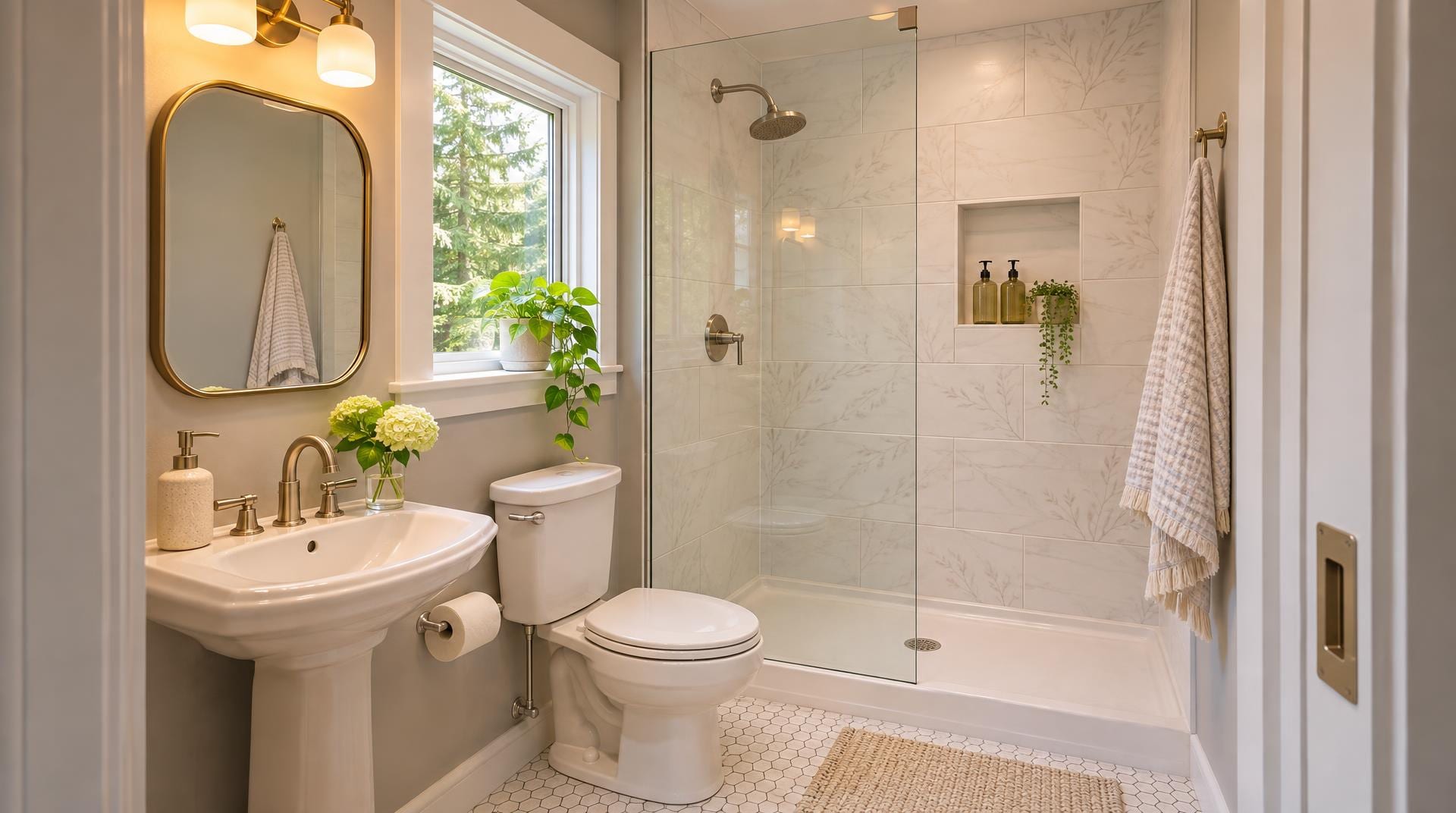
You can turn a tiny half bath into a full bath, even if it’s barely bigger than a coat closet. The usual move is borrowing 2 or 3 feet from a closet or hallway next door. Moving a non-bearing interior wall costs far less than a load-bearing one, so the first thing I check is which way the joists run and what sits on top of that wall.
The Plumbing Question That Decides Your Budget
Plumbing location drives cost more than any finish you pick. The closer the new shower drain sits to your existing drain and vent stack, the less you spend.
Crawlspace, slab, or second floor
- Crawlspace: Good news. Many older homes in Puyallup, Sumner, and Graham sit on crawlspaces, and that makes running a new drain much easier than most homeowners expect.
- Slab: The plumber has to cut and trench the concrete to run the drain, then patch it. That adds real cost.
- Second floor over living space: The drain has to run inside the joist bays with proper slope, and sometimes the ceiling below has to come open.
Old pipes and hot water
Homes built between the 1940s and 1970s often still have galvanized or cast iron lines. When I find old galvanized, I’d rather replace it back to a good connection than tie new PEX into a pipe with rust inside it. A new shower also adds real demand on your water heater, so check its size and age before you assume it can keep up.
Don’t forget the fan
Most half bath fans handle odors, not shower steam. Washington’s energy code requires bath fans that vent to the outside, not into the attic, with a minimum of 50 CFM for intermittent use. My bathroom exhaust fan replacement guide covers sizing and duct runs, and in our climate this step keeps mold off your new ceiling.
What I Find Behind the Walls in Older Pierce County Homes
I’ve been burned by underbidding jobs where the hidden scope blew up once the walls came open. That lesson cost me money early on, and it’s why I talk about contingency before I talk about tile colors.
Here’s what shows up most when I open a half bath wall in a 1960s or 1970s house around South Hill, Lakewood, or Edgewood:
- Rot around an old toilet flange or under a leaky sink supply
- Galvanized or cast iron drain and supply lines near the end of their life
- 60 to 100 amp electrical panels with little room for a new bathroom circuit
- Out-of-level floors that need leveling before large tile goes down
- Wiring that predates GFCI protection, which every bathroom outlet needs today
I spent 5 years as a B-52 crew chief in the Air Force. You don’t skip steps on a bomber, and I don’t skip the crawlspace or the panel when I’m pricing a bathroom. Checking those two things before you sign keeps a $15,000 bid from turning into a $25,000 surprise.
Bathroom and Laundry Room Conversion: Moving Plumbing to Build a New Walk-In Shower
This Pierce County job shows what’s possible when the existing room doesn’t fit what you need. The homeowners wanted the bathroom and the laundry room in each other’s spots, so I swapped them.
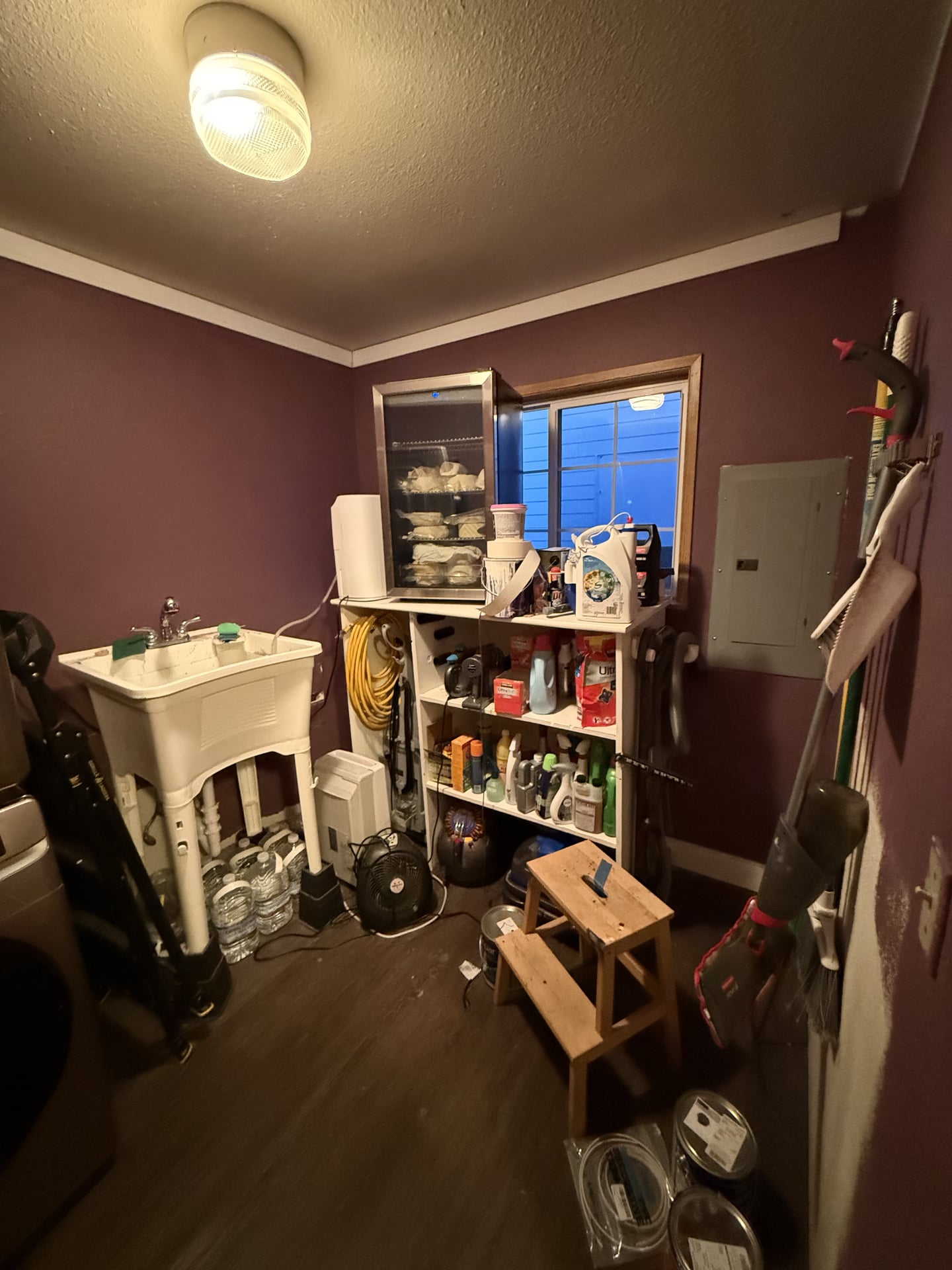
Here’s what the work included:
- Took out one wall and moved another
- Cut out a window and installed a beam to open up the new layout
- Built a walk-in shower with a marble-look tile surround and a rain showerhead
- Installed a new toilet and a pedestal sink with matte black fixtures
- Gave the laundry room a quartz countertop, new sink and faucet, and cabinetry
- Finished with new drywall, doors, and paint throughout

The takeaway for your conversion is simple. Walls can move. Plumbing can move. A beam can carry a load so you get the room you want, but each of those steps adds cost, which is why I always price the “keep it where it is” option first. You can see the full set of photos on the bathroom and laundry room conversion project page.
Half Bath to Dog Wash Station Conversion: When a Shower Isn’t the Goal
Not every half bath needs to become a full bath. On this Pierce County project, the homeowners turned a half bath into a dedicated dog wash station instead.
I removed the wall and the toilet, then tore out the closet to open up the space. That’s the same closet-borrowing move that makes room for a shower in a tight half bath. The wash station got porcelain tile, a herringbone tile surround, storage underneath, and a handheld sprayer, plus new light fixtures and switches throughout.

If your family needs a mudroom wash-down more than a second shower, this is worth a look. See the half bath to dog wash station project page for more photos.
Permits for a Half-to-Full Conversion in Puyallup and Pierce County
Adding a shower means new plumbing, so you need a permit. You’ll likely need an electrical permit too for the new fan circuit and GFCI outlets, and a building permit if any walls move.
| Permit Type | Typical Cost |
|---|---|
| Plumbing or electrical permit | $250 - $400 each |
| Building permit | $750 - $1,450 |
| Total range for most bathroom jobs | $250 - $1,500 |
A few things trip people up:
- Know your jurisdiction. The City of Puyallup and unincorporated Pierce County run separate permit departments. Your address decides which one you call.
- Puyallup Permit Center: 333 S. Meridian, (253) 864-4165, option 1. They take applications through an online portal.
- Inspections: Expect at least a plumbing rough-in inspection and a plumbing final.
- Contractor registration: Anyone doing the work should hold a Washington State L&I contractor registration.
Unpermitted plumbing work can come back to bite you when you sell, because a buyer’s inspector will ask about a bathroom the county records don’t show. My guide to remodeling permits in Puyallup walks through the whole process.
How Long a Half-to-Full Bath Conversion Takes
Plan on 3 to 5 weeks of construction for a standard conversion. If you move walls or relocate plumbing a long way, plan on 6 to 8 weeks.
That clock starts after permits and materials, not before. Here’s the real sequence:
- Design and selections. Pick your shower, tile, vanity, and fixtures before anyone swings a hammer.
- Permit review. Plan for this to take weeks, not days.
- Material lead times. Specialty tile and some fixtures take 4 to 8 weeks to arrive.
- Demo and rough-in. Plumbing, electrical, and framing, then rough-in inspections.
- Waterproofing, tile, and fixtures. Waterproofing needs cure time, and nobody can rush it.
- Final inspection and glass. Glass often comes last because the installer measures the finished tile.
If this half bath is your second bathroom, you can live in the house the whole time. That alone makes a conversion easier than remodeling your only bathroom.
Half Bath Addition Cost: Adding a New Half Bath Where None Exists
Some homeowners searching this topic don’t have a half bath yet. They want to add one. That’s a different job with a different price.
Cost to add a half bath inside your existing house
Start with my half bath remodel range of $6,500 to $16,000. Then add the work a remodel doesn’t need: framing new walls, running a new drain, vent, and water lines, adding a circuit, and venting a fan to the outside. Under-stair spaces and large hall closets are the usual candidates, and the same plumbing rules apply, so a spot close to an existing kitchen or bathroom wet wall costs far less than one across the house. My half bathroom remodel cost guide covers what drives the half bath side of the number.
Adding square footage for a new bathroom
If you need to build out past your current walls, you’re pricing a home addition, not a remodel. That means foundation, framing, roofing, and a longer permit review, often 3 to 4 months start to finish. My home addition cost guide for Puyallup covers those numbers.
How to Keep Your Conversion Near the Low End of the Range
“Good, fast, or cheap. Pick two.” I say that on almost every consultation. Here’s how you push cost down without cutting corners on the parts that matter:
- Keep the toilet and sink where they are. Every fixture that moves adds plumbing labor.
- Put the shower on the wet wall. Line it up with existing drain and vent lines.
- Choose standard-size porcelain. It costs less to buy and less to set than large slabs or handmade tile.
- Consider LVP for the floor. At $11 to $17 per square foot installed, it’s waterproof and saves real money over tile.
- Pick framed glass or a curtain rod. Frameless looks great, but it’s a $1,500 to $3,500 line item.
- Make every decision before demo. Every “actually, can we change that?” adds time and cost.
Where I won’t cut corners is waterproofing, venting, and anything inside the walls. If this were my mom’s house, I’d want that hidden work done right, because that’s the part that fails first in our wet climate.
Questions to Ask Any Contractor Before You Sign
The biggest homeowner mistake I see is choosing on price alone. A lowball bid often leaves scope out, then the change orders start after your bathroom is already torn up and you can’t easily switch contractors. Compare bids line by line.
- Does the bid include the shower drain, vent, and water supply rough-in?
- Does it include a waterproofing system by name, like KERDI or RedGard?
- Does it include a new exhaust fan vented to the outside?
- Does it include permits, or do those sit on top?
- How does the contractor handle change orders and hidden damage?
- Are they registered with Washington L&I, insured, and bonded?
- What warranty do they offer if something fails?
- Can they show you photos of past bathroom work and give you references?
If one bid comes in thousands lower than the others, find out what’s missing. There’s usually a reason it’s the cheapest.
Common Questions About Turning a Half Bath Into a Full Bath
How much does it cost to turn a half bath into a full bath? In the Puyallup area, plan on $13,000 to $32,000 before sales tax. A simple shower addition with nearby plumbing lands near the low end. Moving walls, slab cutting, or premium finishes push you toward the top or past it.
How much does it cost to add a half bath where there isn’t one now? Start with $6,500 to $16,000, which covers remodeling an existing half bath, then add framing, new plumbing runs, electrical, and venting. If the new room needs square footage the house doesn’t have, you’re pricing an addition instead.
Can I add a tub instead of a shower? Yes, if you have the room. A standard tub needs about 60 inches of wall length, so it usually means borrowing more space than a shower stall. If your house has only one tub already, it’s fine to make this one a shower. If it has none, a tub helps families with young kids and helps at resale.
Does converting a half bath to a full bath add value? Mid-range bathroom projects return about 60 to 70% of their cost at resale here. The bigger benefit is often how your listing reads, because going from 1.5 baths to 2 full baths changes who searches for your home. I’d do it for how you live first and treat resale as a bonus.
Can I stay home during the work? Yes, as long as you have another working bathroom. I set up dust barriers and keep the rest of the house usable.
Do I need a permit to add a shower? Yes. Any new plumbing needs a permit in Puyallup and Pierce County, and you’ll likely need electrical and building permits too.
Also Serving Homeowners Across Pierce County
I help homeowners with half-to-full bath conversions and full bathroom remodeling in Puyallup and nearby communities, including Tacoma, Sumner, Bonney Lake, South Hill, Edgewood, and Lakewood.
Get Your Free Half-to-Full Bath Estimate
Every half bath is different, and the only way to give you a real number is to see the room, the crawlspace, and the panel. I’ll walk the space with you, tell you which layout fits, and explain exactly where your money goes before you commit to anything.
Contact me here to get your free estimate, or call me directly at (253) 392-9266.
Brad Zemke, Owner Pacific Remodeling LLC Puyallup, WA